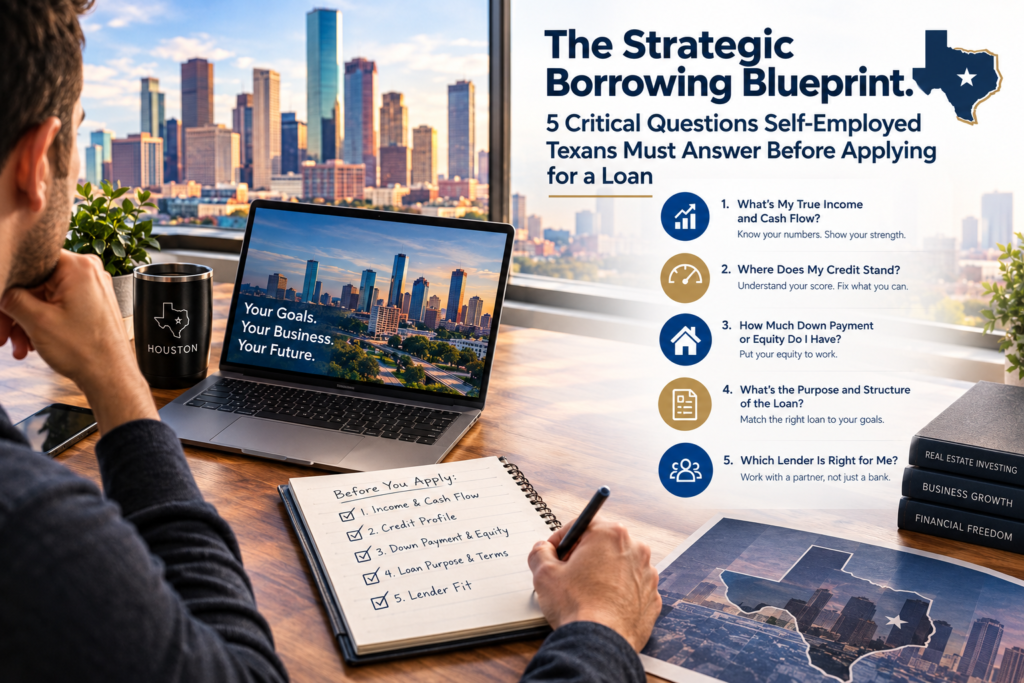
Loans are arguably the most convenient and highly effective financial tools available to get your biggest professional dreams off the ground. Whether you are looking to secure a residential property, scale a local enterprise, or seize a time-sensitive commercial real estate opportunity, capital financing can provide a fast, incredibly powerful path to achieving what you want.
However, securing a loan in today’s shifting economic climate can often be a deeply perplexing and exhausting process for the everyday person.
The modern lending landscape requires you to ponder a myriad of moving parts before you ever start filling out formal loan applications or gathering legal paperwork. Your personal balance sheets, your corporate cash-flow statements, your structural debt-to-income (DTI) ratios, and your long-term repayment models will all be put under the underwriter’s microscope. For a self-employed business owner, independent contractor, or freelancer in Houston, Texas, walking blindly into a traditional bank without a precise plan is a recipe for an immediate, wealth-stifling rejection.
At IndyBanc, we believe that proper preparation is the ultimate key to unlocking elite capital. To ensure your next financing pursuit is a smooth, highly successful, and deeply profitable venture, you must sit down and answer these five critical borrowing questions before approaching any capital provider.
Question 1: Am I Certain That I Will Pass Underwriting for This Specific Loan?
If the honest answer to this question is a definitive “no,” you need to stop yourself immediately before making a costly financial mistake.
Applying for financing at institutions where you know you might be completely out of your depth, or where your self-employed file does not match their rigid criteria, is a highly counterproductive strategy. The unfortunate reality of modern credit infrastructure is that conventional lenders run a hard inquiry on your credit report the moment you apply. Every time your application is rejected for a loan, it leaves a negative footprint on your record, lowering your credit score and making it significantly harder for you to secure competitive funding from alternative lenders in the future.
Conventional Bank Route vs. IndyBanc Alternative Route
- Conventional Bank Route: Rigid, automated “yes/no” algorithms | Blind hard credit inquiries upfront | High risk of self-employed rejection
- IndyBanc Alternative Route: Hands-on capital advisory screening | Soft-pull pre-vetting to protect scores | Strategic alignment with Non-QM products
Instead of playing a high-stakes guessing game with big banks, it is always better to play it safe, protect your credit profile, and steer clear of lenders who do not understand your business model.
At IndyBanc, we completely eliminate this anxiety. As a specialized capital advisory firm, we pre-vet your financial profile through a soft credit analysis, ensuring your file matches the exact parameters of the loan product before a formal application is ever submitted. If a conventional pathway poses a risk of rejection, we instantly pivot your strategy toward flexible, self-employed alternative financing options.
Question 2: Do I Have a Precise, Data-Driven Calculation of the Capital I Need?
Lenders are universally irritated by potential borrowers who approach them with rough, unverified estimates of how much money they need. If you walk into a credit meeting guessing your funding requirements or lacking detailed cash-flow projections, you instantly signal to the underwriter that you lack administrative control over your enterprise.
Before you ever approach a capital provider, you must map out exactly how much funding your project demands down to the cent.
- If you are buying real estate: Calculate your exact down payment, structural closing costs, title fees, and post-closing liquid reserves.
- If you are seeking working capital: Develop an intricate breakdown of how the capital will be deployed—whether it is purchasing capital equipment, scaling inventory, or launching an aggressive marketing expansion.
Knowing your exact number protects your profit margins. If you borrow too little money, you risk stalling out mid-project without finishing the job. If you borrow too much money, you end up paying unnecessary interest and origination fees on capital that is sitting idle in a corporate checking account.
Question 3: Is My Gross Cash Flow Strong Enough to Easily Support the Debt?
At the end of the day, lenders want absolute certainty that you can be relied upon to make regular, consistent monthly payments without default. Therefore, as an independent borrower, you need to prove to them that your cash flow is not only adequate enough to cover the new mortgage note or line of credit, but that your business model leaves a healthy, comfortable room for error as well.
The Repayment Cash-Flow Matrix
| Cash-Flow Position | Underwriter Perception | Approval Probability |
|---|---|---|
| Razor-Thin Margins | High Default Risk / Volatile | Extreme Risk of Rejection |
| Comfortable Buffer | Stable, Well-Managed | Highly Approvable |
| Substantial Surplus | Elite Target Prospect | Unlocks Prime Rates & Terms |
If an underwriting team reviews your bank deposits and sees that a minor shift in the local Houston economy or a brief seasonal drop in revenue would cause you to miss a payment, they will flag your file.
However, if they see that your business can incur an unexpected loss, weather an operational emergency, and still possess more than enough net liquidity to satisfy your monthly debt obligations, they are highly motivated to fund your deal. You must demonstrate that your company operates with a protective cash-flow cushion that insulates both your business and the lender’s investment.
Question 4: How Do My Business and Personal Credit Scores Look?
While a strong personal credit score is an exceptional financial foundation, it can be completely overshadowed if your business credit profile is in a state of neglect.
Think of it this way: if the vendors, suppliers, and local partners you do business with on a daily basis are unsatisfied with your payment history, or if public records show late payments and collections on your business trade lines, little to nothing will convince a commercial lender that you are an upstanding prospect for an elite loan.
- [ Stellar Personal FICO ] + [ Neglected Business Credit ] = Institutional Rejection
- [ Mindful Cash Management ] + [ Clean Trade Lines ] = Streamlined Capital Approval
Managing your business credit score requires you to be intensely mindful of your daily operational finances. You must protect your commercial score with the same discipline you use to guard your personal credit:
- Pay your business vendors, suppliers, and trade lines on or ahead of time.
- Monitor your business credit bureaus (such as Dun & Bradstreet, Experian Business, and Equifax Business) to quickly dispute inaccuracies.
- Ensure your corporate entities (LLCs or Corporations) are kept in good standing with the Texas Comptroller.
A clean business credit profile proves to underwriters that you treat your financial obligations with absolute professional respect.
Question 5: What Do My Holistic Personal Finances Look Like?
When you apply for a loan as a self-employed individual, a traditional lender will point a keen, highly critical eye directly at your holistic personal finances. For a conventional retail bank, you represent a good prospect for a loan only if your personal debts, auto loans, credit cards, and existing primary mortgages are impeccably managed, structured, and organized beforehand.
Conventional underwriters calculate your personal Debt-to-Income (DTI) ratio using a strict mathematical formula. If your personal credit card balances are maxed out, or if you carry high-interest revolving consumer debt, your DTI ratio will skyrocket. This can instantly disqualify you from standard commercial or residential bank financing, even if your underlying business is highly profitable. Before submitting a loan application, you must clean up your personal balance sheet, pay down high-interest consumer lines, and optimize your personal financial health.
Bypassing the Bank Blocks: The IndyBanc Alternative Advantage
Answering these five foundational questions honestly will reveal exactly why so many self-employed business owners hit an immediate brick wall when they approach traditional banks for financing. Conventional banking systems are designed exclusively for standard corporate W-2 employees. They do not know how to evaluate the complex, fluctuating, and creative income structures of a true entrepreneur.
Fortunately, you do not have to rely on traditional, rigid bank gates to fund your next big venture.
At IndyBanc, we specialize in providing alternative capital solutions designed specifically for Houston’s self-employed community, freelancers, and independent 1099 contractors. If your personal tax returns show heavy write-offs that lower your net income, or if your personal DTI ratio doesn’t fit into a standard bank’s automated software box, we deploy specialized Non-QM (Non-Qualified Mortgage) loan products to unlock the liquidity you deserve:
- 12-to-24 Month Bank Statement Loans: We bypass conventional tax return requirements entirely. Instead of looking at your net taxable income line, our underwriters evaluate 12 to 24 months of your actual business or personal bank statements, calculating your true borrowing leverage based on your gross monthly deposits and real-world cash flow.
- Debt Service Coverage Ratio (DSCR) Loans: For entrepreneurs looking to scale an income-producing residential or multi-family rental property portfolio, we offer DSCR mortgages that completely ignore personal income and DTI ratios. The loan is underwritten and approved based entirely on the standalone rental revenue generated by the real estate asset itself.
- Asset Depletion & Alternative Commercial Financing: For high-net-worth business owners with substantial liquid assets, we convert your total wealth into a compliant income stream to secure premier real estate, providing fast, flexible commercial lines and property financing without traditional institutional red tape.
Building a Wealth Machine with IndyBanc and Gabne
Paired with the right financial knowledge, securing a loan is not nearly as daunting or overwhelming as the mainstream media makes it seem. When you align yourself with the right strategies, you can easily make the intelligent, calculated decisions that generate massive wealth and value for yourself, your business, and your family.
To maximize this leverage, your business must operate as an integrated financial and marketing engine. That is where the premier alliance between IndyBanc and our sister company, Gabne, gives the independent Texas entrepreneur an unmatched competitive advantage. We don’t just clear the path for your loan approvals—we install the business infrastructure needed to optimize your revenue and scale your operations automatically:
- Transparent Merchant and Processing Services: To ensure your business cash flow remains unburdened by unnecessary operational costs, IndyBanc provides state-of-the-art credit card processing services. By eliminating hidden transaction fees and accelerating funding clearing speeds, we optimize your daily liquid revenue, making it effortless to sustain your post-closing cash reserves and keep your cash-flow buffers strong.
- Inbound Revenue Optimization via Gabne: Every successful borrowing strategy requires steady, predictable top-line revenue growth. Gabne builds and deploys high-velocity digital marketing frameworks, hyper-targeted local search engine optimization (SEO), and conversion-driven brand acquisition campaigns. Gabne drives a consistent stream of high-value clients directly to your business, automatically boosting your monthly gross deposits, fortifying your borrowing leverage, and giving you the power to dominate your local market.
Stop letting traditional bank guidelines limit your entrepreneurial vision. Take full control of your capital structures, answer the critical financial questions, and partner with a team that knows how to fund your independence.
Contact IndyBanc today, and let’s collaborate to build a sophisticated capital roadmap tailored to your true entrepreneurial strength. By the American entrepreneur, for the American entrepreneur. Let’s fund your real estate empire together!