Buying a home should be an exciting milestone, not a frustrating process filled with unexpected roadblocks. Yet for many entrepreneurs, freelancers, contractors, consultants, and business owners, getting approved for a mortgage can feel significantly more difficult than it does for traditional employees.
One of the biggest reasons is that conventional mortgage underwriting was primarily designed around borrowers with predictable W-2 income. Self-employed professionals often have more complex financial profiles, making it harder for traditional lenders to evaluate their true earning potential.
As a result, many qualified business owners hear the same disappointing response:
“Your loan application has been denied.”
Industry trends continue to show that self-employed borrowers face a much higher denial rate than traditional wage earners because their income is documented differently, not necessarily because they earn less.
The good news is that a mortgage denial does not always mean you cannot qualify for home financing. In many cases, it simply means you need a lending solution designed for self-employed borrowers.
At IndyBanc, helping entrepreneurs and business owners secure financing for investments, commercial, construction, rehab, and business loans is at the core of what they do. Understanding why applications are denied is the first step toward improving your approval chances.
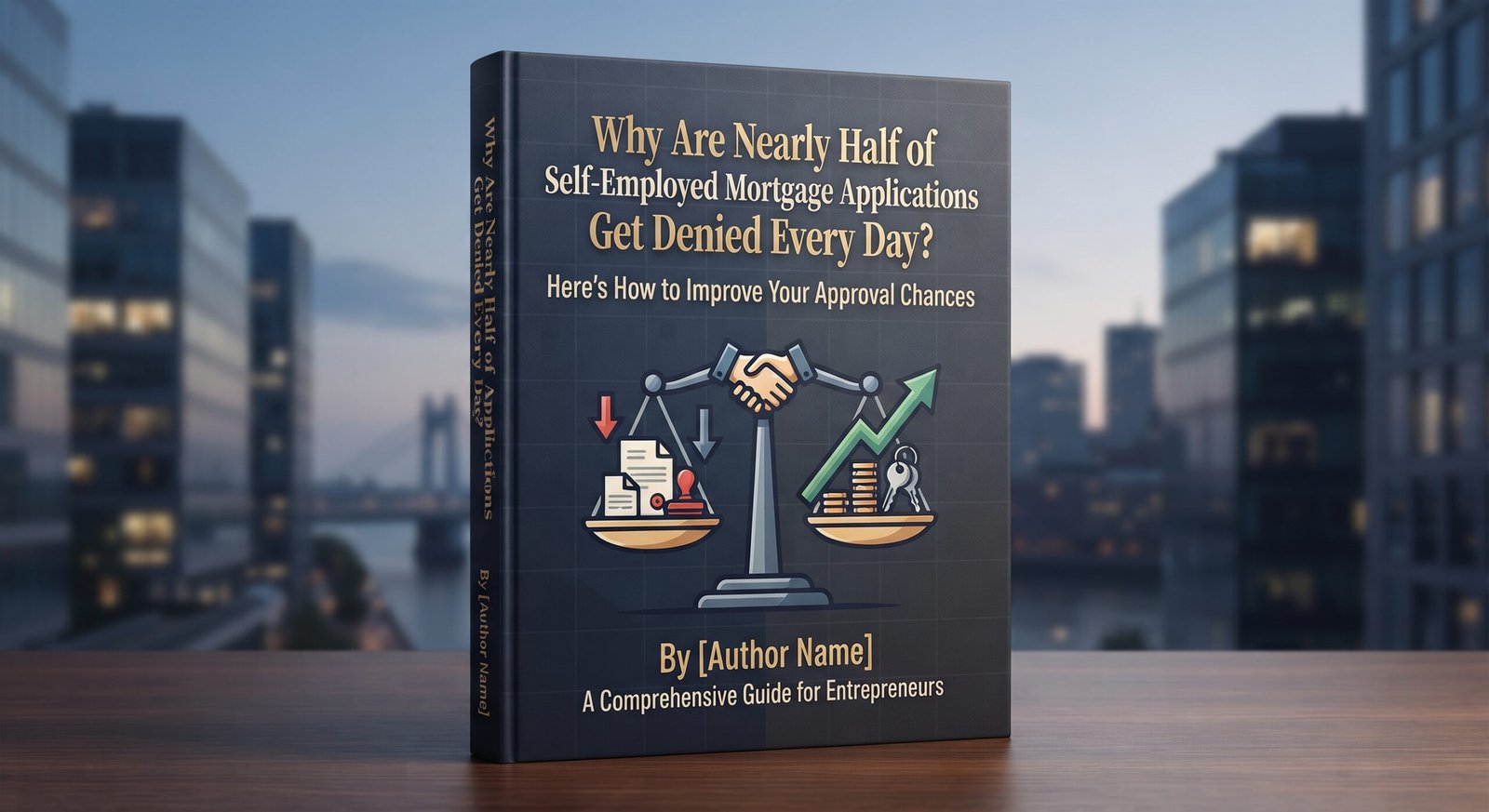
Why Self-Employed Mortgage Applications Get Denied More Often
Owning a successful business does not automatically make qualifying for a mortgage easier. Traditional lenders evaluate borrowers using standardized income verification methods that often do not reflect how self-employed individuals actually earn money.
Instead of looking at business performance as a whole, lenders frequently focus on taxable income shown on tax returns. This creates challenges because many business owners intentionally reduce their taxable income by claiming legitimate business deductions.
While these deductions lower tax liability, they can also make income appear significantly lower during the mortgage approval process. For traditional underwriting, lower taxable income often means reduced borrowing power, even when the business is financially healthy.
The Most Common Reasons Self-Employed Mortgage Applications Are Denied
Understanding why applications are declined helps borrowers avoid common mistakes before applying.
1. Tax Returns Show Lower Income Than Actual Cash Flow
This is by far the most common issue. Business owners regularly deduct expenses such as:
Equipment purchases
Vehicle expenses and business travel
Office costs and marketing expenses
Insurance and depreciation
These deductions are perfectly legitimate from a tax perspective. However, traditional mortgage underwriting often views the reduced taxable income as the borrower’s qualifying income. The result? A financially successful entrepreneur may appear to earn far less on paper than they actually do.
2. Inconsistent Monthly Income
Unlike salaried employees, self-employed income naturally fluctuates. Revenue may vary because of seasonal demand, client payment schedules, project-based work, business expansion, or market conditions. Traditional lenders often prefer stable monthly income, and income fluctuations—even when expected—can create additional underwriting challenges.
3. Limited Employment History
Many mortgage programs require borrowers to demonstrate consistent self-employment history. Recently launched businesses may struggle to qualify even if current revenue is strong. Lenders often look for business longevity, stable income history, and consistent financial performance. Without sufficient history, approval becomes more difficult.
4. High Debt-to-Income Ratio
Traditional mortgage approvals rely heavily on the debt-to-income (DTI) ratio. If existing obligations consume too much reported income, lenders may determine that additional mortgage payments represent excessive financial risk. Ironically, this can happen even when a business generates strong cash flow.
5. Incomplete Financial Documentation
Missing paperwork remains one of the simplest—and most avoidable—reasons mortgage applications are delayed or denied. Common documentation issues include missing bank statements, incomplete tax returns, unverified deposits, business documentation gaps, and missing profit and loss statements. Well-organized documentation significantly improves the underwriting process.
Traditional Banks Don’t Always Tell the Full Financial Story
Many entrepreneurs become discouraged after receiving a mortgage denial. What they often do not realize is that traditional banks simply operate under strict lending guidelines that may not fit self-employed borrowers.
A denial from one lender does not necessarily mean you are not financially qualified. It may simply mean the lender evaluated your income using methods that fail to reflect your actual financial strength. This is where specialized mortgage programs become valuable.
Alternative Mortgage Programs Designed for Self-Employed Borrowers
Over the past several years, alternative documentation mortgage programs have become increasingly popular among entrepreneurs and independent professionals. Rather than relying exclusively on tax returns, these programs may evaluate financial strength using alternative documentation:
Bank Statement Loans: Instead of taxable income alone, lenders review personal or business bank statements to better understand actual cash flow. This option is particularly helpful for business owners who maximize legitimate tax deductions.
Profit & Loss (P&L) Loans: For some borrowers, professionally prepared profit and loss statements can help demonstrate business performance more accurately than tax returns alone.
Asset Qualifier Loans: Some borrowers qualify based on substantial liquid assets rather than traditional employment income, benefiting retirees, investors, or high-net-worth individuals.
DSCR Loans for Real Estate Investors: Real estate investors often qualify based on the property’s cash flow rather than personal employment income, creating additional financing opportunities for investment property purchases.
How to Improve Your Mortgage Approval Chances
Although every borrower is unique, several steps can significantly strengthen a mortgage application:
Maintain Organized Financial Records: Well-organized financial documentation makes underwriting much smoother. Keep current records for business bank statements, personal bank statements, tax returns, business licenses, profit and loss statements, and balance sheets.
Separate Personal and Business Finances: Using separate business accounts improves financial transparency, helping lenders distinguish business income from personal expenses while simplifying documentation.
Reduce Outstanding Debt: Improving your debt-to-income ratio before applying may increase borrowing capacity. Paying down revolving balances and unnecessary debt can strengthen your overall financial profile.
Work With a Broker or a Lender That Understands Self-Employed Borrowers: Perhaps the most important decision is choosing a mortgage broker or lender experienced in serving entrepreneurs. Specialized lenders understand that tax returns do not always reflect true income, business owners manage finances differently, and alternative documentation can provide a clearer financial picture.
Why Houston’s Self-Employed Professionals Need Specialized Mortgage Solutions
Houston continues to be one of the nation’s strongest markets for small business owners, contractors, medical professionals, energy consultants, real estate investors, technology entrepreneurs, and independent professionals.
Many of these borrowers have strong businesses but financial structures that differ from traditional W-2 employees. Mortgage programs designed specifically for self-employed professionals help bridge that gap while supporting homeownership throughout Houston’s growing economy.
Why Are More Entrepreneurs Choosing IndyBanc?
At IndyBanc, the focus is not simply on processing mortgage applications. The goal is understanding how self-employed borrowers actually earn income and identifying financing solutions that fit their financial reality.
Whether you are self-employed, a business owner, a freelancer, a consultant, a real estate investor, or an independent contractor, IndyBanc’s lenders and partners offer mortgage programs designed to address the challenges that traditional lending often overlooks. Instead of forcing every borrower into the same underwriting model, alternative lending solutions help qualified borrowers demonstrate financial strength using documentation that better reflects their business success.
Final Thoughts
Receiving a mortgage denial can feel discouraging, but it does not necessarily mean homeownership is out of reach. For many self-employed professionals, the issue is not income; it is how that income is evaluated.
Understanding why traditional lenders decline self-employed mortgage applications allows borrowers to prepare more effectively and explore financing options better suited to their circumstances. With organized financial records, the right documentation, and a broker or lender experienced in alternative mortgage programs, many entrepreneurs who were previously denied can significantly improve their approval chances.
Choosing a broker or a lender that understands self-employment can make the difference between another rejection and finally receiving the financing needed to purchase your next home.
Frequently Asked Questions
Why do self-employed borrowers get denied for mortgages? The most common reasons include lower taxable income after business deductions, inconsistent income, incomplete financial documentation, high debt-to-income ratios, and traditional underwriting guidelines that rely heavily on tax returns.
Can I qualify for a mortgage without W-2 income? Yes. Many alternative mortgage programs are designed specifically for self-employed borrowers who do not receive traditional W-2 income.
What is a bank statement loan? A bank statement loan allows eligible borrowers to qualify using personal or business bank statements instead of relying primarily on tax returns.
Will business tax deductions affect my mortgage approval? Potentially. While deductions reduce taxable income, they can also reduce the qualifying income traditional lenders use during mortgage underwriting.
What is the best mortgage option for self-employed business owners? The best solution depends on your financial situation. Programs such as bank statement loans, P&L loans, NQ Loans, DSCR loans, and asset-based loans are commonly used by self-employed borrowers who may not qualify under conventional lending guidelines.
Legal Disclosure: IndyBanc operates as a nationwide mortgage broker, holding approval and contractual agreements with numerous lending institutions, bankers, and wholesale lenders. In most states, IndyBanc is not required to obtain a license; however, where licensing is mandated for certain types of loans such as owner-occupied loans, we may refer your loan to a licensed broker in compliance with state regulations. IndyBanc does not originate regulated loans in any state.
Spend enough time scrolling online and you are bound to run into one of these sweeping, dramatic headlines:
Millennials Are Not Buying Homes!
Generation Z and Y Are Moving Completely Away From Diamonds.
Youngsters Terrified of Credit Cards.
The underlying narrative is always the same: the younger generations just beginning to gain financial independence are not spending, borrowing, or investing their money the way their parents once did. They are opting for energy-efficient vehicles or ride-sharing apps over car ownership, choosing flexible rentals over buying real estate, and largely moving away from the traditional consumer milestones of the past.
All of these milestones cost capital. The generations before them had little to no problem taking out conventional loans and mortgages to fund their lives—so what changed?
A lot has changed since the 1980s. While there are many complex structural reasons why young adults today feel like the proverbial cards are stacked against them, the prevailing factor putting them at an unfair disadvantage is a highly turbulent economy combined with a systemic lack of institutional financial literacy.
Finance management is not a genetic skill you are born with. It is a discipline that must be actively learned and practiced, much like mastering a second language or advanced mathematics. Unfortunately, millions of young adults missed out on this crucial part of their education.
To make matters more challenging, a massive portion of this demographic consists of ambitious, self-employed creators, tech freelancers, 1099 contractors, and boutique business owners right here in Houston, Texas. They are driven by an unmatched entrepreneurial spirit, but they have no idea where to start when it comes to funding their dreams.
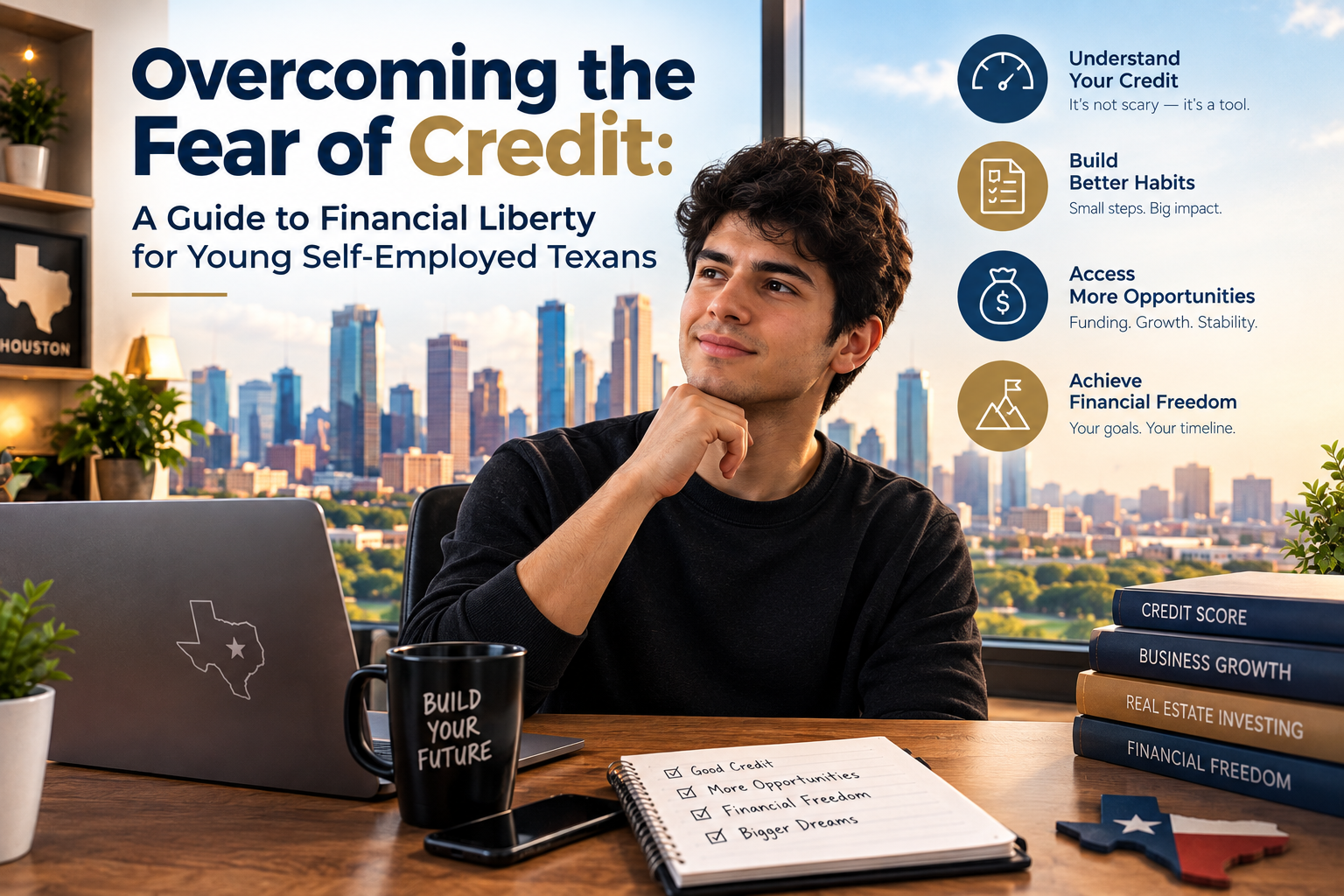
At IndyBanc, we believe that avoiding credit out of fear is the single greatest bottleneck to building wealth. This guide will dismantle the generational fear surrounding debt, break down how the credit system actually works, and reveal how young independent operators can leverage smart financing to claim their economic freedom.
The Iceberg of Financial Fear: Student Debt and Economic Scars
The lack of financial literacy is not at all unique to this particular generation. However, what is unique is the constant economic turbulence younger adults were born into. Financial catastrophes like the Great Recession left a lasting psychological scar, making an entire generation hesitant to invest in the stock market or trust traditional banking institutions.
Then came the student loan crisis. Even though aggregate student debt does not equal the total volume of national mortgage debt, the burden of monthly student loans has caused the very word “loan” to carry a deeply negative, restrictive connotation in the minds of young people.
Driven by an institutional lack of transparency, these fears rule their financial decisions, keeping them from learning about the immense wealth-building power of calculated leverage. This anxiety doubles when a young person decides to start their own business or work as a freelancer.
When they seek professional advice or look at a traditional bank, they are met with rigid underwriting corporate checklists, cold algorithms, and zero guidance. They end up feeling completely alienated by a system that demands two years of corporate W-2 paystubs just to buy a starter home or secure a small business line of credit.
Changing the Narrative: Debt is Not Inherently Evil
The solution to this systemic problem is not simple. Just telling people that loans are valid tools isn’t enough to erase decades of financial anxiety. Coming off economic shifts and navigating a rapidly evolving market can make the landscape feel incredibly bleak. But constant pessimism will never help an entrepreneur reach the pinnacle of success they are chasing after.
There needs to be an active, intentional effort from young adults to pursue financial education and business growth. If you or someone you know is just entering the phase of life where you are making your own long-term financial decisions, take your time to learn and understand how the lending process actually operates.
Loans of any kind are not innately evil or predatory. They are highly regulated financial systems put in place to help a functioning, free-market society prosper. Educating yourself about these systems is a fundamental responsibility for every young citizen looking to build true stability.
When utilized correctly, borrowing capital is simply the process of buying time. Instead of spending fifteen years saving raw cash to buy a commercial storefront or a residential home—all while inflation erodes the purchasing power of your dollars—a mortgage allows you to claim ownership of that appreciating asset today, using the bank’s liquidity to fund your future.
The IndyBanc Alternative: Tailored Solutions for the Next Generation
At IndyBanc, we refuse to let generational anxiety or rigid, old-school bank guidelines crush the ambitions of Houston’s young entrepreneurs, freelancers, and independent contractors. We know that your financial footprint looks different than a traditional 9-to-5 corporate executive’s. You don’t have a W-2 paystub, and your tax returns likely show smart, legal business deductions that write down your net taxable income.
Unlike a traditional bank loan officer who works as an enforcement agent for the institution, IndyBanc works exclusively for the borrower. We serve as your financial co-pilots, taking the time to explain the system, keep you completely in the light, and ensure that no financial move is ever executed without your explicit, fully informed approval.
To help young self-employed Texans get their dreams off the ground, we provide direct access to specialized Non-QM (Non-Qualified Mortgage) loan products that completely bypass traditional big bank hurdles:
1. 12-to-24 Month Bank Statement Loans
If you have been running a successful freelance business, digital agency, or local service company for at least one to two years, we eliminate the requirement for traditional tax transcripts. Instead, our alternative underwriters analyze 12 to 24 months of your actual business or personal bank statements, verifying your true borrowing leverage based on your gross monthly deposits and real-world cash flow. This protects your legal tax write-offs while unlocking maximum purchasing power.
2. Debt Service Coverage Ratio (DSCR) Investor Loans
For young adults looking to bypass the volatile stock market and build an ironclad portfolio of residential or multi-family rental properties, our DSCR mortgage program is a total game-changer.
This loan completely ignores personal income, tax returns, and personal debt-to-income (DTI) metrics. The underwriting decision is based entirely on a simple cash-flow calculation: Does the projected gross rental income of the property cover the monthly mortgage payment (PITI)? If the real estate asset breaks even or turns a net profit, the loan is approved, allowing you to scale a real estate empire completely independent of your personal background.
Establishing the Ultimate Foundation with IndyBanc and Gabne
Securing your first alternative mortgage or business line of credit is an incredible milestone, but true financial independence means your business must operate as an integrated, cash-generating engine. That is where the complete dual-company power of IndyBanc and our sister company, Gabne, gives the next generation of Texas entrepreneurs an unmatched competitive advantage.
We don’t just clear the path for your loan approvals—we install the permanent financial and marketing infrastructure your enterprise needs to optimize your cash flow and scale automatically:
Transparent Capital Allocation: We navigate our extensive nationwide network of non-QM portfolio lenders and private funds to match your exact business objectives with the most suitable, cost-effective loan products, walking you through every line item with total transparency.
Streamlined Merchant and Credit Processing: To ensure your daily business revenues remain strong and completely insulated from predatory operational leakage, IndyBanc provides state-of-the-art credit card processing services. We strip away hidden merchant transaction fees and speed up your funding clearing times, leaving more liquid profit inside your corporate accounts to build your cash reserves.
Automated Lead Generation via Gabne: Every premier borrowing blueprint requires a consistent stream of inbound revenue to sustain it. Gabne builds and deploys high-velocity digital marketing frameworks, targeted local search engine optimization (SEO), and high-converting customer acquisition campaigns. Gabne builds the marketing engine that drives high-value clients straight to your business, automatically boosting your monthly gross deposits, fortifying your borrowing leverage, and giving you the power to dominate your market.
Get Your Pre-Approval Letter in Minutes
If you have questions about loans—whether it is a residential mortgage, a commercial property acquisition, a business line of credit, or how to properly structure an alternative bank statement file—do not let fear or confusion keep you in the dark.
Give us a call today. Our capital advisors will patiently answer your questions, break down your options with complete honesty, and explain the entire underwriting process.
If you are ready to start house hunting or bidding on commercial property, we will pre-qualify you and issue a formal “Pre-Approval Letter,” emailing it directly to your inbox within a few minutes after we hang up, guaranteed. Stop letting old-school bank rules and institutional anxiety dictate the boundaries of your success. Take full control of your financial education, partner with a team that fights exclusively for your benefit, and let’s fund your independence. By the American entrepreneur, for the American entrepreneur. Let’s build your financial future together!
Spend enough time scrolling online and you are bound to run into one of these sweeping, dramatic headlines:
Millennials Are Not Buying Homes!
Generation Z and Y Are Moving Completely Away From Diamonds.
Youngsters Terrified of Credit Cards.
The underlying narrative is always the same: the younger generations just beginning to gain financial independence are not spending, borrowing, or investing their money the way their parents once did. They are opting for energy-efficient vehicles or ride-sharing apps over car ownership, choosing flexible rentals over buying real estate, and largely moving away from the traditional consumer milestones of the past.
All of these milestones cost capital. The generations before them had little to no problem taking out conventional loans and mortgages to fund their lives—so what changed?
A lot has changed since the 1980s. While there are many complex structural reasons why young adults today feel like the proverbial cards are stacked against them, the prevailing factor putting them at an unfair disadvantage is a highly turbulent economy combined with a systemic lack of institutional financial literacy.
Finance management is not a genetic skill you are born with. It is a discipline that must be actively learned and practiced, much like mastering a second language or advanced mathematics. Unfortunately, millions of young adults missed out on this crucial part of their education.
To make matters more challenging, a massive portion of this demographic consists of ambitious, self-employed creators, tech freelancers, 1099 contractors, and boutique business owners right here in Houston, Texas. They are driven by an unmatched entrepreneurial spirit, but they have no idea where to start when it comes to funding their dreams.
At IndyBanc, we believe that avoiding credit out of fear is the single greatest bottleneck to building wealth. This guide will dismantle the generational fear surrounding debt, break down how the credit system actually works, and reveal how young independent operators can leverage smart financing to claim their economic freedom.
The Iceberg of Financial Fear: Student Debt and Economic Scars
The lack of financial literacy is not at all unique to this particular generation. However, what is unique is the constant economic turbulence younger adults were born into. Financial catastrophes like the Great Recession left a lasting psychological scar, making an entire generation hesitant to invest in the stock market or trust traditional banking institutions.
Then came the student loan crisis. Even though aggregate student debt does not equal the total volume of national mortgage debt, the burden of monthly student loans has caused the very word “loan” to carry a deeply negative, restrictive connotation in the minds of young people.
Driven by an institutional lack of transparency, these fears rule their financial decisions, keeping them from learning about the immense wealth-building power of calculated leverage. This anxiety doubles when a young person decides to start their own business or work as a freelancer.
When they seek professional advice or look at a traditional bank, they are met with rigid underwriting corporate checklists, cold algorithms, and zero guidance. They end up feeling completely alienated by a system that demands two years of corporate W-2 paystubs just to buy a starter home or secure a small business line of credit.
Changing the Narrative: Debt is Not Inherently Evil
The solution to this systemic problem is not simple. Just telling people that loans are valid tools isn’t enough to erase decades of financial anxiety. Coming off economic shifts and navigating a rapidly evolving market can make the landscape feel incredibly bleak. But constant pessimism will never help an entrepreneur reach the pinnacle of success they are chasing after.
There needs to be an active, intentional effort from young adults to pursue financial education and business growth. If you or someone you know is just entering the phase of life where you are making your own long-term financial decisions, take your time to learn and understand how the lending process actually operates.
Loans of any kind are not innately evil or predatory. They are highly regulated financial systems put in place to help a functioning, free-market society prosper. Educating yourself about these systems is a fundamental responsibility for every young citizen looking to build true stability.
When utilized correctly, borrowing capital is simply the process of buying time. Instead of spending fifteen years saving raw cash to buy a commercial storefront or a residential home—all while inflation erodes the purchasing power of your dollars—a mortgage allows you to claim ownership of that appreciating asset today, using the bank’s liquidity to fund your future.
The IndyBanc Alternative: Tailored Solutions for the Next Generation
At IndyBanc, we refuse to let generational anxiety or rigid, old-school bank guidelines crush the ambitions of Houston’s young entrepreneurs, freelancers, and independent contractors. We know that your financial footprint looks different than a traditional 9-to-5 corporate executive’s. You don’t have a W-2 paystub, and your tax returns likely show smart, legal business deductions that write down your net taxable income.
Unlike a traditional bank loan officer who works as an enforcement agent for the institution, IndyBanc works exclusively for the borrower. We serve as your financial co-pilots, taking the time to explain the system, keep you completely in the light, and ensure that no financial move is ever executed without your explicit, fully informed approval.
To help young self-employed Texans get their dreams off the ground, we provide direct access to specialized Non-QM (Non-Qualified Mortgage) loan products that completely bypass traditional big bank hurdles:
1. 12-to-24 Month Bank Statement Loans
If you have been running a successful freelance business, digital agency, or local service company for at least one to two years, we eliminate the requirement for traditional tax transcripts. Instead, our alternative underwriters analyze 12 to 24 months of your actual business or personal bank statements, verifying your true borrowing leverage based on your gross monthly deposits and real-world cash flow. This protects your legal tax write-offs while unlocking maximum purchasing power.
2. Debt Service Coverage Ratio (DSCR) Investor Loans
For young adults looking to bypass the volatile stock market and build an ironclad portfolio of residential or multi-family rental properties, our DSCR mortgage program is a total game-changer.
This loan completely ignores personal income, tax returns, and personal debt-to-income (DTI) metrics. The underwriting decision is based entirely on a simple cash-flow calculation: Does the projected gross rental income of the property cover the monthly mortgage payment (PITI)? If the real estate asset breaks even or turns a net profit, the loan is approved, allowing you to scale a real estate empire completely independent of your personal background.
Establishing the Ultimate Foundation with IndyBanc and Gabne
Securing your first alternative mortgage or business line of credit is an incredible milestone, but true financial independence means your business must operate as an integrated, cash-generating engine. That is where the complete dual-company power of IndyBanc and our sister company, Gabne, gives the next generation of Texas entrepreneurs an unmatched competitive advantage.
We don’t just clear the path for your loan approvals—we install the permanent financial and marketing infrastructure your enterprise needs to optimize your cash flow and scale automatically:
Transparent Capital Allocation: We navigate our extensive nationwide network of non-QM portfolio lenders and private funds to match your exact business objectives with the most suitable, cost-effective loan products, walking you through every line item with total transparency.
Streamlined Merchant and Credit Processing: To ensure your daily business revenues remain strong and completely insulated from predatory operational leakage, IndyBanc provides state-of-the-art credit card processing services. We strip away hidden merchant transaction fees and speed up your funding clearing times, leaving more liquid profit inside your corporate accounts to build your cash reserves.
Automated Lead Generation via Gabne: Every premier borrowing blueprint requires a consistent stream of inbound revenue to sustain it. Gabne builds and deploys high-velocity digital marketing frameworks, targeted local search engine optimization (SEO), and high-converting customer acquisition campaigns. Gabne builds the marketing engine that drives high-value clients straight to your business, automatically boosting your monthly gross deposits, fortifying your borrowing leverage, and giving you the power to dominate your market.
Get Your Pre-Approval Letter in Minutes
If you have questions about loans—whether it is a residential mortgage, a commercial property acquisition, a business line of credit, or how to properly structure an alternative bank statement file—do not let fear or confusion keep you in the dark.
Give us a call today. Our capital advisors will patiently answer your questions, break down your options with complete honesty, and explain the entire underwriting process.
If you are ready to start house hunting or bidding on commercial property, we will pre-qualify you and issue a formal “Pre-Approval Letter,” emailing it directly to your inbox within a few minutes after we hang up, guaranteed. Stop letting old-school bank rules and institutional anxiety dictate the boundaries of your success. Take full control of your financial education, partner with a team that fights exclusively for your benefit, and let’s fund your independence. By the American entrepreneur, for the American entrepreneur. Let’s build your financial future together!
The landscape of American real estate is undergoing an unprecedented shift. Across the country, the volume of default notices, foreclosure filings, and distressed properties has created a unique window of economic transformation. For the average observer, headlines highlighting turbulent real estate cycles create hesitation. However, for elite real estate investment professionals, this volatility represents a generational opportunity to generate monumental profits.
When structural market corrections yield high numbers of foreclosures and short sales, they generate vast inventories of deeply discounted assets. Smart investors do not view these as signs of a collapsing system; instead, they treat these “lemons” as raw material to create financial “lemonade.”
Success in this arena requires more than just identifying distressed assets. True wealth generation relies on how those assets are structured, scaled, and funded. Choosing between a traditional Fix & Flip execution or a long-term Fix & Keep rental strategy is a pivotal decision.
More importantly, your choice of financial partner directly dictates your trajectory. By moving away from traditional, restrictive banking structures and leveraging the specialized, creative financing solutions of an elite direct private lender like IndyBanc, investors can protect their liquidity, maximize their leverage, and safely scale a single asset into a multi-million-dollar real estate empire.
Deconstructing the Market: The Reality of Distressed Assets
When people hear the term “Fix & Flip” or “Buy & Hold,” they often picture single-family residential properties. While single-family residences are excellent foundational assets, a sophisticated investor understands that distressed debt and short-sale opportunities span the entire spectrum of real estate asset classes.
Through innovative financing models, any asset with clear structural upside and an attractive entry valuation can be acquired and repositioned. These asset profiles regularly include:
Residential Portfolios: Single-family homes (1–4 units), townhouses, and suburban condominiums.
Commercial and Multi-Family: High-density apartment complexes (5+ units), student housing, and mixed-use commercial properties.
Hospitality and Luxury Properties: Boutique hotels, high-rise luxury towers, master-planned resorts, and premier golf courses.
Specialty Capital Assets: Any complex investment property or cash-flowing operational asset that features an advantageous risk-adjusted margin.
The core mechanics of the business remain consistent across all property types: acquire an undervalued property, systematically eliminate its physical or operational deficiencies, and execute an optimized exit strategy that extracts maximum value.
Private Money vs. Traditional Institutional Lending
To understand why sophisticated investors achieve rapid growth, one must examine the capital structures that fund their portfolios. Relying on traditional institutional banks for active real estate investments is fundamentally inefficient. Traditional banks operate on standard, slow underwriting timelines, demand exhaustive income verifications, and enforce highly restrictive loan-to-value limitations. In a fast-moving market where the most lucrative deals close in a matter of days, waiting 45 to 60 days for a conventional bank approval will cause you to lose high-margin opportunities to more agile buyers.
Private institutional money, by contrast, represents the highest standard of strategic real estate capital. It treats money as a dynamic tool for leverage rather than an anchor of debt.
Short-Term Capital Solutions
For active rehabilitation projects, short-term private loans provide the velocity and flexibility required to execute rapid transitions. With interest rates ranging between 6.49% and 12% and terms spanning 12 to 18 months, this funding mechanism prioritizes speed and asset value over a borrower’s historical paperwork. It allows investors to access capital quickly, secure properties below market value, complete extensive renovations, and position the asset for a premium exit before the loan reaches maturity.
Long-Term Stabilization Capital
For investors pursuing a legacy wealth strategy, the goal shifts from short-term liquidation to long-term cash flow generation. Private financing accommodates this transition smoothly. Fixed 30-year loans are available for Buy, Fix & Keep rental strategies with rates starting as low as 6%. This allows you to smoothly transition from a high-velocity rehab structure into a stabilized, long-term cash-flowing mortgage, preserving your personal capital while building significant equity.
The Strategic Advantage of IndyBanc: Engineering Wealth Through Creative Financing
Many private lenders act as simple transactional funding sources, charging capital fees without adding strategic value to the transaction. IndyBanc operates differently, serving as a dedicated institutional partner focused on maximizing investor wealth. By utilizing advanced underwriting mechanics and asset-based strategies, IndyBanc changes how investors structure their transactions, turning financing into a primary driver of investment profitability.
Traditional Financing: Slow approvals $\rightarrow$ Capital tied down $\rightarrow$ Rigid limits $\rightarrow$ Linear growth
IndyBanc Financing: Rapid Proof of Funds $\rightarrow$ High leverage $\rightarrow$ Cross-collateralization $\rightarrow$ Geometric scaling
1. Advanced Leverage Optimization (Maximizing the Capital Stack)
The primary constraint on real estate growth is the exhaustion of liquid cash reserves. If an investor injects all of their personal liquid capital into a single property, their growth stops immediately until that asset is sold or refinanced. IndyBanc eliminates this barrier through optimized capital structuring. By funding up to 90% of the property acquisition costs and 100% of the renovation budget, IndyBanc reduces your required initial cash investment. This keeps your capital highly liquid, allowing you to deploy resources across multiple concurrent projects and scale your business exponentially.
2. Strategic Cross-Collateralization
For active investors with existing real estate portfolios, IndyBanc unlocks dormant capital through tailored cross-collateralization strategies. If you own equity in a stabilized commercial asset or a portfolio of rental properties, IndyBanc can structure financing that uses that equity to secure new acquisitions. This creative approach can allow you to achieve 100% financing on new acquisitions, completely eliminating the need for out-of-pocket down payments. This framework lets you build your portfolio continuously by leveraging your existing holdings without triggering taxable liquidation events.
3. Professional Negotiation with Sellers and Financial Institutions
IndyBanc’s involvement extends far beyond providing capital; the firm acts as a powerful ally during complex transaction negotiations. When you are acquiring assets out of foreclosure, navigating delicate short sales, or purchasing properties from distressed asset managers, having a seasoned, highly capitalized financial partner fundamentally shifts the power dynamic in your favor.
Lender-to-Lender Negotiation: In short-sale and bank-owned (REO) transactions, IndyBanc’s underwriting team interfaces directly with the selling institution’s asset managers. Because IndyBanc deeply understands institutional debt structures, they can present concrete asset evaluations and verified capital commitments that convince selling banks to discount principal balances, waive outstanding fees, and clear complex liens to expedite the sale.
Seller Concessions and Terms Optimization: When negotiating with private sellers, an IndyBanc approval completely changes your positioning. Sellers often prioritize certainty of closing over the final sales price. By providing a verified, institutional “Proof of Funds” and demonstrating an accelerated closing timeframe, IndyBanc gives you the leverage to demand substantial price discounts, seller-paid closing costs, or favorable repair credits during escrow.
4. Custom Transitional Bridge Financing
Real estate opportunities rarely arrive in neat, simple packages. Investors frequently encounter properties that are deeply undervalued but suffer from temporary operational issues—such as structural code violations, high vacancy rates, or missing certificates of occupancy. These issues make the property ineligible for standard bank funding. IndyBanc specializes in structuring custom bridge solutions designed to cross these gaps. This transitional capital funds the property through its immediate crisis, providing the necessary runway to stabilize the asset and qualify it for premium long-term institutional financing.
The Master Blueprint: 4 Phases to Investment Mastery
Achieving elite returns in real estate requires a systematic, repeatable approach to managing risk and executing projects. Elite investors follow a rigorous four-phase framework to consistently manufacture equity across every transaction.
Phase 1: Institutional Sourcing and Strict Due Diligence
Locating a deeply discounted property is only the first step. True investment mastery requires an exhaustive evaluation of data to ensure the asset possesses a genuine financial upside. Sourcing should combine digital real estate networks, direct-to-owner marketing campaigns, and specialized real estate agents who focus exclusively on off-market commercial and residential distress.
Once a potential property is identified, you must initiate a rigorous dual-track due diligence process:
Valuation Data Analysis: An investor must remain completely objective, separating emotional appeal from analytical facts. You must analyze comprehensive property records, historical tax assessments, regional macro-economic growth data, and hyper-local neighborhood safety statistics. The foundational metric for any project is the After Repair Value (ARV), which must be accurately calculated by evaluating recent comparable sales (comps) of fully renovated properties within a tight geographic radius.
Risk Mitigation Protocols: Every property file must be cross-referenced against local zoning databases to identify outstanding building code violations, unpermitted historic additions, hazardous material liabilities (such as asbestos or environmental soil contamination), and updated municipal flood zone designations.
Complete Physical Inspection Framework: Before confirming your project budget, you must execute a comprehensive physical inspection covering both interior and exterior systems:
Inspection Zone
Critical Component Checklist
Interior Infrastructure
Complete pressure testing of plumbing lines, main sewer scopes, electrical panel capacities, HVAC mechanical lifespans, structural load-bearing analysis, door/window seals, and active security integrations.
Exterior Structural Shell
Core drilling of foundations, roofing longevity, framing assessments, exterior wall facings, grading angles for surface water drainage, ingress/egress safety compliance, and immediate environmental hazards.
Phase 2: Transaction Execution and Closing Protection
The closing phase is where your profits are legally locked in. Veteran investors understand that speed must always be paired with absolute legal protection. By working alongside specialized real estate attorneys, utilizing established escrow institutions, and obtaining comprehensive title insurance examinations, you ensure that your investments are entirely insulated from hidden liabilities. This step guarantees that your ownership is secure, completely free of surprise mechanic’s liens, historical tax judgments, or unresolved estate disputes from past owners.
Phase 3: Strategic Property Rehabilitation and Contractor Governance
The renovation phase is often where inexperienced investors encounter major challenges. Managing timelines and tracking expenses requires strict operational discipline. Your profit margin depends entirely on your ability to deliver high-quality renovations on time and within your projected budget.
To protect your capital, you must enforce a rigorous contractor selection and governance policy. Every general contractor and specialty trade professional working on your asset must provide:
A valid state contracting license in active, unblemished standing.
Comprehensive general liability insurance and current worker’s compensation coverage.
Verified corporate references from established commercial and residential projects.
A signed, milestone-based contract that dictates funds are only released after independent verification of completed work, paired with unconditional partial lien waivers to protect you from future mechanic’s liens.
Phase 4: Executing the Exit Strategy (The Wealth Decision)
The final phase requires a clear analysis of your portfolio goals. Once the property is fully renovated and stabilized, you must execute the optimal exit strategy based on current market dynamics and your long-term wealth objectives:
Option A (The “Flip”): You place the pristine, retail-ready asset onto the open market to sell it to an owner-occupant or traditional buyer. This strategy unlocks maximum liquidity, yields immediate capital gains, and frees up your resources to pursue larger, more ambitious opportunities.
Option B (The “Keep”): You retain the asset, lease it to quality tenants, and transition the short-term construction debt into a long-term IndyBanc 30-year rental loan. This move creates predictable monthly passive cash flow, opens up valuable tax depreciation benefits, and allows you to build substantial long-term wealth as the property appreciates over time.
Streamlining Success: Pre-Approval and Documentation with IndyBanc
In the competitive world of high-velocity real estate, timing is everything. The most profitable opportunities, the ones with the largest equity margins, are bought and sold quickly. If you find a deeply discounted property but have to wait days to organize your financials or secure a lender’s attention, another investor will capitalize on your delay and claim the asset.
To prevent this, sophisticated investors secure institutional pre-approval with IndyBanc before they begin evaluating properties.
When you enter negotiations backed by a formal pre-approval, your market positioning changes instantly. You are no longer just an interested buyer submitting a hopeful offer; you are a fully capitalized investor with the verified backing of a premier private institution. IndyBanc supports your position by issuing an official, customized “Proof of Funds” letter. This document signals to sellers, bank asset managers, and real estate brokers that you have the financial capacity to close the deal rapidly without traditional financing delays.
The Investor Documentation Checklist
To fast-track your institutional approval and secure your Proof of Funds letter, compile a comprehensive digital package containing the following essential items:
Official Personal Identification: A valid, active state driver’s license, a verified Social Security documentation card, or a current foreign national passport.
Liquid Capital Statements: Two consecutive months of complete, unaltered bank statements across all personal and corporate accounts (including all pages and summary schedules).
Corporate Entity Documentation: Executed operating agreements, formal state certificates of good standing, and your certified articles of organization or corporate charter.
Executed Purchase Contract: The finalized purchase and sale agreement (applicable if you are currently submitting a property transaction for immediate funding).
Historical Settlement Disclosures: A certified HUD-1 settlement statement or clear closing documentation proving original purchase costs (required for investors executing an equity cash-out refinance transaction).
Active Hazard Insurance Policies: Current binder documentation demonstrating full property and liability coverage (required for stabilization or refinance lending structures).
Comprehensive Builder’s Risk Coverage: A valid 12-month builder’s risk policy designed to cover property assets through major renovation or structural construction phases.
Closing Professional Contact Data: Complete contact information (direct names, office addresses, telephone numbers, and email contacts) for your designated title insurance company or closing attorney.
Granular Construction Budget (Scope of Work): A highly detailed, line-item budget mapping out every component of the property renovation phase, complete with materials costs, labor projections, and specific project timelines.
The real estate market continuously rewards speed, leverage, and clear execution. While traditional financing channels slow down growth with rigid guidelines and extended timelines, IndyBanc provides real estate professionals with the speed, leverage, and tailored financing models required to thrive in any economic environment.
By utilizing creative capital structures, protecting your cash reserves, and drawing on institutional expertise to negotiate directly with sellers and major financial institutions, IndyBanc turns everyday real estate transactions into significant wealth-building opportunities.
Do not wait for the perfect deal to arrive before securing your financing. Take control of your portfolio’s growth, establish your institutional leverage, and position your business to act instantly when opportunity calls.
Complete Your Submission Today
Organize your application documents and email each file as a separate digital attachment to: info@indybanc.com
Once received, IndyBanc’s elite underwriting team will review your files, fast-track your corporate loan approval, and issue your official institutional Proof of Funds letter. Partner with IndyBanc today, protect your capital, deploy smart leverage, and take your real estate enterprise to the next level!
Advanced Leverage Optimization (Maximizing the Capital Stack) The primary constraint on real estate growth is the exhaustion of liquid cash reserves. If an investor injects all of their personal liquid capital into a single property, their growth stops immediately until that asset is sold or refinanced. IndyBanc eliminates this barrier through optimized capital structuring. By funding up to 90% of the property acquisition costs and 100% of the renovation budget, IndyBanc reduces your required initial cash investment. This keeps your capital highly liquid, allowing you to deploy resources across multiple concurrent projects and scale your business exponentially.
Strategic Cross-Collateralization For active investors with existing real estate portfolios, IndyBanc unlocks dormant capital through tailored cross-collateralization strategies. If you own equity in a stabilized commercial asset or a portfolio of rental properties, IndyBanc can structure financing that uses that equity to secure new acquisitions. This creative approach can allow you to achieve 100% financing on new acquisitions, completely eliminating the need for out-of-pocket down payments. This framework lets you build your portfolio continuously by leveraging your existing holdings without triggering taxable liquidation events.
Professional Negotiation with Sellers and Financial Institutions IndyBanc’s involvement extends far beyond providing capital; the firm acts as a powerful ally during complex transaction negotiations. When you are acquiring assets out of foreclosure, navigating delicate short sales, or purchasing properties from distressed asset managers, having a seasoned, highly capitalized financial partner fundamentally shifts the power dynamic in your favor. Lender-to-Lender Negotiation: In short-sale and bank-owned (REO) transactions, IndyBanc’s underwriting team interfaces directly with the selling institution’s asset managers. Because IndyBanc deeply understands institutional debt structures, they can present concrete asset evaluations and verified capital commitments that convince selling banks to discount principal balances, waive outstanding fees, and clear complex liens to expedite the sale. Seller Concessions and Terms Optimization: When negotiating with private sellers, an IndyBanc approval completely changes your positioning. Sellers often prioritize certainty of closing over the final sales price. By providing a verified, institutional “Proof of Funds” and demonstrating an accelerated closing timeframe, IndyBanc gives you the leverage to demand substantial price discounts, seller-paid closing costs, or favorable repair credits during escrow.
Custom Transitional Bridge Financing Real estate opportunities rarely arrive in neat, simple packages. Investors frequently encounter properties that are deeply undervalued but suffer from temporary operational issues—such as structural code violations, high vacancy rates, or missing certificates of occupancy. These issues make the property ineligible for standard bank funding. IndyBanc specializes in structuring custom bridge solutions designed to cross these gaps. This transitional capital funds the property through its immediate crisis, providing the necessary runway to stabilize the asset and qualify it for premium long-term institutional financing. The Master Blueprint: 4 Phases to Investment Mastery Achieving elite returns in real estate requires a systematic, repeatable approach to managing risk and executing projects. Elite investors follow a rigorous four-phase framework to consistently manufacture equity across every transaction. Phase 1: Institutional Sourcing and Strict Due Diligence Locating a deeply discounted property is only the first step. True investment mastery requires an exhaustive evaluation of data to ensure the asset possesses a genuine financial upside. Sourcing should combine digital real estate networks, direct-to-owner marketing campaigns, and specialized real estate agents who focus exclusively on off-market commercial and residential distress. Once a potential property is identified, you must initiate a rigorous dual-track due diligence process:
Valuation Data Analysis An investor must remain completely objective, separating emotional appeal from analytical facts. You must analyze comprehensive property records, historical tax assessments, regional macro-economic growth data, and hyper-local neighborhood safety statistics. The foundational metric for any project is the After Repair Value (ARV), which must be accurately calculated by evaluating recent comparable sales (comps) of fully renovated properties within a tight geographic radius. [Raw Property Purchase] + [Strategic Capital Renovation] = [Target ARV / Premium Market Value]
Risk Mitigation Protocols Every property file must be cross-referenced against local zoning databases to identify outstanding building code violations, unpermitted historic additions, hazardous material liabilities (such as asbestos or environmental soil contamination), and updated municipal flood zone designations.
Complete Physical Inspection Framework Before confirming your project budget, you must execute a comprehensive physical inspection covering both interior and exterior systems: Inspection Zone Critical Component Checklist Interior Infrastructure Complete pressure testing of plumbing lines, main sewer scopes, electrical panel capacities, HVAC mechanical lifespans, structural load-bearing analysis, door/window seals, and active security integrations. Exterior Structural Shell Core drilling of foundations, roofing longevity, framing assessments, exterior wall facings, grading angles for surface water drainage, ingress/egress safety compliance, and immediate environmental hazards. Phase 2: Transaction Execution and Closing Protection The closing phase is where your profits are legally locked in. Veteran investors understand that speed must always be paired with absolute legal protection. By working alongside specialized real estate attorneys, utilizing established escrow institutions, and obtaining comprehensive title insurance examinations, you ensure that your investments are entirely insulated from hidden liabilities. This step guarantees that your ownership is secure, completely free of surprise mechanic’s liens, historical tax judgments, or unresolved estate disputes from past owners. Phase 3: Strategic Property Rehabilitation and Contractor Governance The renovation phase is often where inexperienced investors encounter major challenges. Managing timelines and tracking expenses requires strict operational discipline. Your profit margin depends entirely on your ability to deliver high-quality renovations on time and within your projected budget. To protect your capital, you must enforce a rigorous contractor selection and governance policy. Every general contractor and specialty trade professional working on your asset must provide: A valid state contracting license in active, unblemished standing. Comprehensive general liability insurance and current worker’s compensation coverage. Verified corporate references from established commercial and residential projects. A signed, milestone-based contract that dictates funds are only released after independent verification of completed work, paired with unconditional partial lien waivers to protect you from future mechanic’s liens. Phase 4: Executing the Exit Strategy (The Wealth Decision) The final phase requires a clear analysis of your portfolio goals. Once the property is fully renovated and stabilized, you must execute the optimal exit strategy based on current market dynamics and your long-term wealth objectives: ┌──> Option A: THE FLIP ───> Immediate Cash Profit (High Velocity Capital) │ STABILIZED ASSET ─┤ │ └──> Option B: THE KEEP ───> 30-Year Rental Loan (Passive Income & Equity)
Option A: The “Flip” Strategy You place the pristine, retail-ready asset onto the open market to sell it to an owner-occupant or traditional buyer. This strategy unlocks maximum liquidity, yields immediate capital gains, and frees up your resources to pursue larger, more ambitious opportunities. Option B: The “Keep” Strategy You retain the asset, lease it to quality tenants, and transition the short-term construction debt into a long-term IndyBanc 30-year rental loan. This move creates predictable monthly passive cash flow, opens up valuable tax depreciation benefits, and allows you to build substantial long-term wealth as the property appreciates over time. Streamlining Success: Pre-Approval and Documentation with IndyBanc In the competitive world of high-velocity real estate, timing is everything. The most profitable opportunities, the ones with the largest equity margins, are bought and sold quickly. If you find a deeply discounted property but have to wait days to organize your financials or secure a lender’s attention, another investor will capitalize on your delay and claim the asset. To prevent this, sophisticated investors secure institutional pre-approval with IndyBanc before they begin evaluating properties. When you enter negotiations backed by a formal pre-approval, your market positioning changes instantly. You are no longer just an interested buyer submitting a hopeful offer; you are a fully capitalized investor with the verified backing of a premier private institution. IndyBanc supports your position by issuing an official, customized “Proof of Funds” letter. This document signals to sellers, bank asset managers, and real estate brokers that you have the financial capacity to close the deal rapidly without traditional financing delays. The Investor Documentation Checklist To fast-track your institutional approval and secure your Proof of Funds letter, compile a comprehensive digital package containing the following essential items: Official Personal Identification: A valid, active state driver’s license, a verified Social Security documentation card, or a current foreign national passport. Liquid Capital Statements: Two consecutive months of complete, unaltered bank statements across all personal and corporate accounts (including all pages and summary schedules). Corporate Entity Documentation: Executed operating agreements, formal state certificates of good standing, and your certified articles of organization or corporate charter. Executed Purchase Contract: The finalized purchase and sale agreement (applicable if you are currently submitting a property transaction for immediate funding). Historical Settlement Disclosures: A certified HUD-1 settlement statement or clear closing documentation proving original purchase costs (required for investors executing an equity cash-out refinance transaction). Active Hazard Insurance Policies: Current binder documentation demonstrating full property and liability coverage (required for stabilization or refinance lending structures). Comprehensive Builder’s Risk Coverage: A valid 12-month builder’s risk policy designed to cover property assets through major renovation or structural construction phases. Closing Professional Contact Data: Complete contact information (direct names, office addresses, telephone numbers, and email contacts) for your designated title insurance company or closing attorney. Granular Construction Budget (Scope of Work): A highly detailed, line-item budget mapping out every component of the property renovation phase, complete with materials costs, labor projections, and specific project timelines. Elevate Your Real Estate Enterprise [ Prepare Documentation Package ] ──> [ Email to info@indybanc.com ] ──> [ Receive Institutional Approval ] The real estate market continuously rewards speed, leverage, and clear execution. While traditional financing channels slow down growth with rigid guidelines and extended timelines, IndyBanc provides real estate professionals with the speed, leverage, and tailored financing models required to thrive in any economic environment. By utilizing creative capital structures, protecting your cash reserves, and drawing on institutional expertise to negotiate directly with sellers and major financial institutions, IndyBanc turns everyday real estate transactions into significant wealth-building opportunities. Do not wait for the perfect deal to arrive before securing your financing. Take control of your portfolio’s growth, establish your institutional leverage, and position your business to act instantly when opportunity calls. Complete Your Submission Today Organize your application documents and email each file as a separate digital attachment to: info@indybanc.com Once received, IndyBanc’s elite underwriting team will review your files, fast-track your corporate loan approval, and issue your official institutional Proof of Funds letter. Partner with IndyBanc today, protect your capital, deploy smart leverage, and take your real estate enterprise to the next level!
Advanced Leverage Optimization (Maximizing the Capital Stack) The primary constraint on real estate growth is the exhaustion of liquid cash reserves. If an investor injects all of their personal liquid capital into a single property, their growth stops immediately until that asset is sold or refinanced. IndyBanc eliminates this barrier through optimized capital structuring. By funding up to 90% of the property acquisition costs and 100% of the renovation budget, IndyBanc reduces your required initial cash investment. This keeps your capital highly liquid, allowing you to deploy resources across multiple concurrent projects and scale your business exponentially.
Strategic Cross-Collateralization For active investors with existing real estate portfolios, IndyBanc unlocks dormant capital through tailored cross-collateralization strategies. If you own equity in a stabilized commercial asset or a portfolio of rental properties, IndyBanc can structure financing that uses that equity to secure new acquisitions. This creative approach can allow you to achieve 100% financing on new acquisitions, completely eliminating the need for out-of-pocket down payments. This framework lets you build your portfolio continuously by leveraging your existing holdings without triggering taxable liquidation events.
Professional Negotiation with Sellers and Financial Institutions IndyBanc’s involvement extends far beyond providing capital; the firm acts as a powerful ally during complex transaction negotiations. When you are acquiring assets out of foreclosure, navigating delicate short sales, or purchasing properties from distressed asset managers, having a seasoned, highly capitalized financial partner fundamentally shifts the power dynamic in your favor. Lender-to-Lender Negotiation: In short-sale and bank-owned (REO) transactions, IndyBanc’s underwriting team interfaces directly with the selling institution’s asset managers. Because IndyBanc deeply understands institutional debt structures, they can present concrete asset evaluations and verified capital commitments that convince selling banks to discount principal balances, waive outstanding fees, and clear complex liens to expedite the sale. Seller Concessions and Terms Optimization: When negotiating with private sellers, an IndyBanc approval completely changes your positioning. Sellers often prioritize certainty of closing over the final sales price. By providing a verified, institutional “Proof of Funds” and demonstrating an accelerated closing timeframe, IndyBanc gives you the leverage to demand substantial price discounts, seller-paid closing costs, or favorable repair credits during escrow.
Custom Transitional Bridge Financing Real estate opportunities rarely arrive in neat, simple packages. Investors frequently encounter properties that are deeply undervalued but suffer from temporary operational issues—such as structural code violations, high vacancy rates, or missing certificates of occupancy. These issues make the property ineligible for standard bank funding. IndyBanc specializes in structuring custom bridge solutions designed to cross these gaps. This transitional capital funds the property through its immediate crisis, providing the necessary runway to stabilize the asset and qualify it for premium long-term institutional financing. The Master Blueprint: 4 Phases to Investment Mastery Achieving elite returns in real estate requires a systematic, repeatable approach to managing risk and executing projects. Elite investors follow a rigorous four-phase framework to consistently manufacture equity across every transaction. Phase 1: Institutional Sourcing and Strict Due Diligence Locating a deeply discounted property is only the first step. True investment mastery requires an exhaustive evaluation of data to ensure the asset possesses a genuine financial upside. Sourcing should combine digital real estate networks, direct-to-owner marketing campaigns, and specialized real estate agents who focus exclusively on off-market commercial and residential distress. Once a potential property is identified, you must initiate a rigorous dual-track due diligence process:
Valuation Data Analysis An investor must remain completely objective, separating emotional appeal from analytical facts. You must analyze comprehensive property records, historical tax assessments, regional macro-economic growth data, and hyper-local neighborhood safety statistics. The foundational metric for any project is the After Repair Value (ARV), which must be accurately calculated by evaluating recent comparable sales (comps) of fully renovated properties within a tight geographic radius. [Raw Property Purchase] + [Strategic Capital Renovation] = [Target ARV / Premium Market Value]
Risk Mitigation Protocols Every property file must be cross-referenced against local zoning databases to identify outstanding building code violations, unpermitted historic additions, hazardous material liabilities (such as asbestos or environmental soil contamination), and updated municipal flood zone designations.
Complete Physical Inspection Framework Before confirming your project budget, you must execute a comprehensive physical inspection covering both interior and exterior systems: Inspection Zone Critical Component Checklist Interior Infrastructure Complete pressure testing of plumbing lines, main sewer scopes, electrical panel capacities, HVAC mechanical lifespans, structural load-bearing analysis, door/window seals, and active security integrations. Exterior Structural Shell Core drilling of foundations, roofing longevity, framing assessments, exterior wall facings, grading angles for surface water drainage, ingress/egress safety compliance, and immediate environmental hazards. Phase 2: Transaction Execution and Closing Protection The closing phase is where your profits are legally locked in. Veteran investors understand that speed must always be paired with absolute legal protection. By working alongside specialized real estate attorneys, utilizing established escrow institutions, and obtaining comprehensive title insurance examinations, you ensure that your investments are entirely insulated from hidden liabilities. This step guarantees that your ownership is secure, completely free of surprise mechanic’s liens, historical tax judgments, or unresolved estate disputes from past owners. Phase 3: Strategic Property Rehabilitation and Contractor Governance The renovation phase is often where inexperienced investors encounter major challenges. Managing timelines and tracking expenses requires strict operational discipline. Your profit margin depends entirely on your ability to deliver high-quality renovations on time and within your projected budget. To protect your capital, you must enforce a rigorous contractor selection and governance policy. Every general contractor and specialty trade professional working on your asset must provide: A valid state contracting license in active, unblemished standing. Comprehensive general liability insurance and current worker’s compensation coverage. Verified corporate references from established commercial and residential projects. A signed, milestone-based contract that dictates funds are only released after independent verification of completed work, paired with unconditional partial lien waivers to protect you from future mechanic’s liens. Phase 4: Executing the Exit Strategy (The Wealth Decision) The final phase requires a clear analysis of your portfolio goals. Once the property is fully renovated and stabilized, you must execute the optimal exit strategy based on current market dynamics and your long-term wealth objectives: ┌──> Option A: THE FLIP ───> Immediate Cash Profit (High Velocity Capital) │ STABILIZED ASSET ─┤ │ └──> Option B: THE KEEP ───> 30-Year Rental Loan (Passive Income & Equity)
Option A: The “Flip” Strategy You place the pristine, retail-ready asset onto the open market to sell it to an owner-occupant or traditional buyer. This strategy unlocks maximum liquidity, yields immediate capital gains, and frees up your resources to pursue larger, more ambitious opportunities. Option B: The “Keep” Strategy You retain the asset, lease it to quality tenants, and transition the short-term construction debt into a long-term IndyBanc 30-year rental loan. This move creates predictable monthly passive cash flow, opens up valuable tax depreciation benefits, and allows you to build substantial long-term wealth as the property appreciates over time. Streamlining Success: Pre-Approval and Documentation with IndyBanc In the competitive world of high-velocity real estate, timing is everything. The most profitable opportunities, the ones with the largest equity margins, are bought and sold quickly. If you find a deeply discounted property but have to wait days to organize your financials or secure a lender’s attention, another investor will capitalize on your delay and claim the asset. To prevent this, sophisticated investors secure institutional pre-approval with IndyBanc before they begin evaluating properties. When you enter negotiations backed by a formal pre-approval, your market positioning changes instantly. You are no longer just an interested buyer submitting a hopeful offer; you are a fully capitalized investor with the verified backing of a premier private institution. IndyBanc supports your position by issuing an official, customized “Proof of Funds” letter. This document signals to sellers, bank asset managers, and real estate brokers that you have the financial capacity to close the deal rapidly without traditional financing delays. The Investor Documentation Checklist To fast-track your institutional approval and secure your Proof of Funds letter, compile a comprehensive digital package containing the following essential items: Official Personal Identification: A valid, active state driver’s license, a verified Social Security documentation card, or a current foreign national passport. Liquid Capital Statements: Two consecutive months of complete, unaltered bank statements across all personal and corporate accounts (including all pages and summary schedules). Corporate Entity Documentation: Executed operating agreements, formal state certificates of good standing, and your certified articles of organization or corporate charter. Executed Purchase Contract: The finalized purchase and sale agreement (applicable if you are currently submitting a property transaction for immediate funding). Historical Settlement Disclosures: A certified HUD-1 settlement statement or clear closing documentation proving original purchase costs (required for investors executing an equity cash-out refinance transaction). Active Hazard Insurance Policies: Current binder documentation demonstrating full property and liability coverage (required for stabilization or refinance lending structures). Comprehensive Builder’s Risk Coverage: A valid 12-month builder’s risk policy designed to cover property assets through major renovation or structural construction phases. Closing Professional Contact Data: Complete contact information (direct names, office addresses, telephone numbers, and email contacts) for your designated title insurance company or closing attorney. Granular Construction Budget (Scope of Work): A highly detailed, line-item budget mapping out every component of the property renovation phase, complete with materials costs, labor projections, and specific project timelines. Elevate Your Real Estate Enterprise [ Prepare Documentation Package ] ──> [ Email to info@indybanc.com ] ──> [ Receive Institutional Approval ] The real estate market continuously rewards speed, leverage, and clear execution. While traditional financing channels slow down growth with rigid guidelines and extended timelines, IndyBanc provides real estate professionals with the speed, leverage, and tailored financing models required to thrive in any economic environment. By utilizing creative capital structures, protecting your cash reserves, and drawing on institutional expertise to negotiate directly with sellers and major financial institutions, IndyBanc turns everyday real estate transactions into significant wealth-building opportunities. Do not wait for the perfect deal to arrive before securing your financing. Take control of your portfolio’s growth, establish your institutional leverage, and position your business to act instantly when opportunity calls. Complete Your Submission Today Organize your application documents and email each file as a separate digital attachment to: info@indybanc.com Once received, IndyBanc’s elite underwriting team will review your files, fast-track your corporate loan approval, and issue your official institutional Proof of Funds letter. Partner with IndyBanc today, protect your capital, deploy smart leverage, and take your real estate enterprise to the next level!
Real estate investing is often described as one of the most effective ways to build long-term wealth. However, one decision can significantly influence the success—or failure—of an investment project before renovations even begin.
Should you use your own cash to finance the entire project, or should you leverage private lending?
Many investors believe paying cash is the safest approach because it eliminates monthly loan payments and interest costs. While that may seem logical, experienced investors understand that tying up all available capital in one project can create serious financial challenges.
Unexpected construction costs, permit delays, labor shortages, and market fluctuations can quickly drain available funds. Once cash reserves are exhausted, investors may struggle to finish renovations, refinance the property, or even keep the project moving.
Over the years, situations like this have become increasingly common.
In one real-world scenario, an investor spent more than $600,000 of personal capital purchasing and renovating an investment property. Before the project reached completion, the available cash was gone. With construction unfinished and funding exhausted, the investor was forced to seek financing after the project had already stalled.
The financing solution eventually helped move the project forward—but the outcome could have been very different if financing had been part of the strategy from the beginning.
This example highlights an important lesson:
Sometimes, preserving your capital is more valuable than spending it.
Why Many Real Estate Investors Prefer Paying Cash
Paying cash offers several obvious advantages. Without lender involvement, investors often enjoy:
Faster closings
Stronger purchase offers
No monthly mortgage payments
Lower closing costs
Greater negotiating power with sellers
For competitive markets, cash purchases may provide an advantage during bidding situations. However, purchasing a property outright is only one part of the investment journey. The real financial challenge often begins after closing.
The Hidden Risk of Using All Your Cash
Buying an investment property is rarely the final expense. Most projects require additional capital for:
Unexpected delays (e.g., pandemic-related construction delays)
Renovations and contractor payments
Increases in building materials (from tariffs, etc.)
Permits, utility work, and landscaping
Property taxes and insurance
Unexpected emergency repairs
Even experienced investors regularly encounter unforeseen expenses such as foundation issues, roof replacements, plumbing failures, electrical upgrades, mold remediation, and HVAC replacements. Each unexpected cost reduces available cash reserves. Without sufficient liquidity, projects can slow dramatically—or stop altogether.
Why Liquidity Matters More Than Many Investors Realize
Liquidity simply means having cash available when opportunities or unexpected expenses arise. Investors with healthy cash reserves can:
Complete renovations on schedule
Handle emergency repairs
Take advantage of new investment opportunities
Cover holding costs during market delays
Avoid financial stress
Investors who commit all available funds to a single property often lose this flexibility. Instead of making strategic decisions, they begin making emergency decisions. That difference can significantly affect long-term profitability.
What Happens When a Project Runs Out of Money?
Running out of capital during a project creates a chain reaction of financial problems:
Construction Delays: Without available funds, contractors may pause work until payments resume, extending delays and increasing total project costs.
Higher Holding Costs: Every additional month a project remains unfinished creates ongoing expenses such as property taxes, insurance, utilities, maintenance, security, and opportunity costs.
Lost Market Opportunities: Real estate markets constantly change, and delays may result in lower resale values, higher interest rates, reduced buyer demand, and missed refinancing opportunities.
Financial Stress: Pressure mounts as investors scramble to find emergency funding simply to complete the project—a situation far more common than many first-time investors expect.
How Private Lending Helps Investors Protect Their Capital
Private lending allows investors to finance part of the project instead of relying exclusively on personal funds. Rather than exhausting available cash during acquisition and renovation, investors preserve capital for future needs.
Private loans can help cover:
Property acquisition
Renovation costs and construction expenses
Bridge financing and investment property purchases
Value-add improvements
Maintaining available capital creates greater financial flexibility throughout the project.
The Power of Financial Leverage
Successful investors understand that real estate is not simply about buying properties; it is about managing capital efficiently. Financial leverage allows investors to:
Preserve liquidity
Diversify investments
Reduce personal financial exposure
Maintain emergency reserves
Scale portfolios more efficiently
Instead of placing $600,000 into one project, an investor may use financing strategically while keeping significant capital available for future investments or unexpected costs. This approach often creates greater long-term stability.
Comparing Private Loans and All-Cash Investing
Private Lending
All-Cash Investing
• Preserves liquidity
• Uses significant personal capital
• Supports multiple projects
• Capital tied to one investment
• Greater financial flexibility
• Limited emergency reserves
• Easier portfolio growth
• Slower expansion
• Improves cash management
• Higher opportunity cost
• Financing costs apply
• No loan interest
Neither approach is universally better. The right strategy depends on investment goals, available capital, risk tolerance, and long-term planning. However, experienced investors often recognize that protecting liquidity is just as important as acquiring the property itself.
When Private Lending Makes the Most Sense
Private financing may be particularly valuable for investors who:
Purchase multiple properties annually
Complete fix-and-flip projects
Invest in value-add properties or renovate distressed homes
Require short-term financing
Want to preserve working capital and expand their investment portfolio
Rather than replacing personal investment, financing becomes part of a broader financial strategy.
Common Misconceptions About Private Loans
Many investors hesitate because they believe private loans are only for borrowers who cannot qualify elsewhere. In reality, experienced investors often choose private financing intentionally—not because they lack capital, but because they understand the value of maintaining liquidity.
Professional investors regularly use financing as a business tool rather than viewing debt as a weakness. Strategic borrowing allows capital to continue working instead of remaining locked inside a single property.
Houston’s Competitive Real Estate Market Makes Capital Management Even More Important
Houston remains one of the country’s most active real estate investment markets. Growing neighborhoods, redevelopment opportunities, and strong housing demand continue attracting investors seeking long-term returns.
In competitive markets like Houston, investors often benefit from maintaining financial flexibility. Having available capital makes it easier to respond quickly to opportunities, handle unexpected renovation costs, secure additional investment properties, and continue growing a portfolio without unnecessary financial pressure. Smart capital management often becomes a competitive advantage.
Why Investors Work With IndyBanc
At IndyBanc, financing is viewed as more than simply funding a transaction. The goal is helping investors structure financing in a way that supports sustainable portfolio growth.
Whether purchasing a rental property, renovating an investment home, refinancing an existing asset, or expanding into additional projects, financing solutions should align with the investor’s overall strategy, not create unnecessary financial strain. Working with experienced lending professionals helps investors evaluate financing options that preserve capital while supporting long-term investment success.
Final Thoughts
Paying cash for an investment property may feel like the safest financial decision, but it is not always the most profitable one. Real estate investing is rarely just about purchasing property; it is about managing capital wisely throughout the entire investment lifecycle.
Unexpected costs, construction delays, and changing market conditions can quickly consume available funds, leaving investors with unfinished projects and limited financial options. Private lending provides an alternative approach by preserving liquidity, reducing financial pressure, and allowing investors to continue growing without exhausting personal capital.
For many successful investors, the question is no longer:
“Can I pay cash?”
Instead, it becomes:
“Should I?”
The answer often depends on which strategy creates the greatest long-term financial flexibility.
Frequently Asked Questions
Is paying cash always the best way to buy investment property? Not necessarily. While paying cash eliminates financing costs, it also ties up significant capital that may be needed for renovations, emergencies, or future investment opportunities.
Why do experienced investors use private loans? Many investors use private loans to preserve liquidity, improve cash flow management, and scale their real estate portfolios more efficiently.
What are the benefits of private lending for real estate investors? Private lending can provide faster financing, preserve working capital, support renovation projects, and improve overall investment flexibility.
Can private loans be used for fix-and-flip projects? Yes. Private financing is commonly used for fix-and-flip properties, renovation projects, bridge financing, and investment property acquisitions.
How do I know which financing strategy is right for me? The right approach depends on your available capital, investment goals, project timeline, risk tolerance, and long-term portfolio strategy. Consulting with an experienced investment property lender can help determine the most effective financing solution.
When it comes to the complex world of corporate capitalization, there is absolutely no “one size fits all” approach. Every distinct loan program is engineered to suit a borrower’s highly specific operational need. If you find yourself operating in the competitive Texas marketplace and you are ready to expand your company’s footprint, buy an office building, or acquire a retail storefront, you must master the mechanics of a commercial real estate loan.
The textbook definition of a commercial loan is a debt facility taken out explicitly by a business entity for commercial purposes rather than by an individual for personal, consumer use. However, in the broader banking landscape, institutional lenders may also classify any high-monetary-value funding request as a commercial loan.
Generally speaking, you can borrow a significantly larger pool of funds through a commercial loan than you ever could with a standard consumer loan or small personal line of credit. Because the capital layout is so substantial, sophisticated portfolio lenders can also structure highly attractive, customized repayment schedules that align with your company’s fiscal cycles.
At IndyBanc, we believe that owning your commercial property is the ultimate milestone of business independence. Renting a commercial space leaves your company vulnerable to landlord disputes, unexpected lease hikes, and zero long-term equity growth.
This comprehensive masterclass will break down the essential rules of commercial property financing, contrast the major structural options available to Houston business owners, and show you how to bypass traditional banking gatekeepers to fund your expansion.
The Reality Check: What It Takes to Qualify for Commercial Capital
If you want your business entity to qualify for a premier commercial real estate loan, there are several strict operational caveats that you must bear in mind.
Firstly, because of the massive volume of funds involved, the overall stakes are significantly higher than in your run-of-the-mill personal loan. Secondly, the overarching process of underwriting, auditing, and procuring a commercial loan through a traditional retail bank can be an incredibly long, frustrating journey that can stall your expansion for months.
Do not let these concerns deter you, though. A commercial loan remains your single best financial option when it comes to developing, purchasing, or building physical property for your business. You simply must be prepared to show the lending market a robust financial foundation:
Strong Collateral Protection: Commercial loans are asset-backed facilities. Lenders require the underlying real estate asset—whether it is a medical office, warehouse, or multi-family complex—to possess strong valuation metrics to secure the debt note.
Documented Business Track Records: Traditional underwriters prefer to see an established, legally compliant entity (LLC, S-Corp, or C-Corp) with a clean operational history, verifying that your company can navigate changing market conditions smoothly.
Sustainable Corporate Revenues: You must demonstrate to the capital provider that your company generates sufficient, high-margin gross revenues to easily absorb the new monthly debt payment while maintaining a healthy operational net profit.
While traditional brick-and-mortar banks subject self-employed borrowers to endless administrative paperwork, modern alternative portfolio networks and agile online lending channels have completely revolutionized the space, making the commercial borrowing process faster, more flexible, and highly accessible.
6 Powerful Commercial Loan Types for Self-Employed Operators
Depending on your specific timeline, your property type, and your current liquid cash reserves, you must evaluate your lending options carefully and select the exact financing mechanism that serves your ultimate goals.
The Commercial Lending Playbook
Loan Type
Primary Focus
Best Use Case
Conventional CRE
Corporate Financial Health
Established Businesses buying stable sites
SBA 504 / 7(a)
Government-Backed Guarantees
High-Leverage (Low Down Payment) Projects
DSCR Commercial
Property Cash Flow Only
Real Estate Investors & Landlords
Hard Money / Bridge
Property Equity & Speed
Rapid Flips, Rehabs, & Time-Sensitive Deals
1. Conventional Commercial Real Estate Loans
With traditional institutional banks, you gain access to the absolute largest pools of capital at the lowest potential interest rates by utilizing a conventional commercial real estate (CRE) loan. However, the barrier to entry here is exceptionally steep.
To win an approval, your enterprise must display stellar, unblemished financial performance across multiple years of audited tax returns. You must also prove a strong, highly predictable potential for another several fiscal years of continuous corporate growth. For self-employed individuals whose tax strategies involve maximizing legal deductions to reduce net income, passing this strict underwriting test is often an impossible hurdle.
2. Small Business Administration (SBA) Loans
For independent business owners who want to preserve their liquid cash reserves, government-backed SBA loans—specifically the SBA 7(a) and SBA 504 programs—represent an incredible option. Because the federal government guarantees a substantial portion of the loan to the bank, lenders can offer highly competitive, long-term fixed rates with down payments as low as 10%.
The Catch: The property must be primarily owner-occupied (typically requiring your business to physically occupy at least 51% of the total square footage), and the administrative approval process requires extensive compliance documentation.
3. Commercial Lines of Credit
A commercial line of credit (LOC) operates as a highly flexible financial safety net for your corporate treasury. Instead of releasing a lump-sum loan, the lender grants your business a maximum borrowing limit.
You can draw capital out of this revolving pool at your leisure to cover immediate inventory surges, purchase marketing campaigns, fund short-term payroll, or secure materials for a new contract. You only owe interest on the exact dollar amount you actively pull out. Once you repay the borrowed balance, your credit limit resets instantly, providing ongoing working capital.
4. Hard Money and Short-Term Bridge Loans
When you are dealing with short-term bridge capital or private hard money loans, you are stepping out of the rigid banking box and partnering directly with private investment networks. These lenders offer short-term capital (typically 12 to 36 months) with slightly higher interest rates and upfront points.
The massive benefit here is that hard money loans are incredibly easy to qualify for and can be funded in a matter of days. Because the loan is guaranteed entirely by the equity and value of the real estate rather than your personal credit profile, you do not need to show a perfect financial record or complex tax returns to secure an approval. It is the ultimate tool for rapid acquisitions or property repositioning.
5. Commercial Asset-Based & Equipment Financing
If your business expansion requires heavy machinery, specialized medical equipment, fleet vehicles, or advanced technology systems alongside your real estate, equipment financing allows you to secure those assets cleanly. The machinery or equipment itself serves as the immediate collateral for the loan, protecting your primary business cash flow from being drained by massive upfront capital expenditures.
6. Non-QM Debt Service Coverage Ratio (DSCR) Commercial Loans
For self-employed professionals acting as real estate investors, commercial DSCR loans represent an elite alternative funding pathway. Under this framework, your personal income, personal debt-to-income (DTI) ratios, and corporate tax returns are completely eliminated from the file.
The alternative underwriter analyzes one primary metric: Does the commercial property’s gross rental income or operational revenue cover the monthly mortgage payment? If the asset cash-flows efficiently, the loan is approved, allowing you to build a commercial property empire completely independent of your personal tax records.
Navigating the Commercial Underwriting Grid
To ensure your file is structured correctly from day one, you must understand the primary mathematical metric commercial underwriters use to grade your file: the Debt Service Coverage Ratio (DSCR).
$$\text{DSCR} = \frac{\text{Net Operating Income (NOI)}}{\text{Annual Debt Service}}$$
If your commercial property generates a Net Operating Income of $125,000 a year, and your total annual mortgage payments equal $100,000, your DSCR sits at a healthy 1.25x. Commercial portfolio lenders traditionally look for a minimum DSCR of 1.15x to 1.25x to ensure your business carries a comfortable cash-flow buffer to handle unexpected vacancies, maintenance emergencies, or local economic shifts.
Bypassing the Bank Blocks: The IndyBanc Advantage
The traditional commercial loan process at retail banks is notorious for stalling out entrepreneurs. Big banks rely on rigid, automated software that treats self-employed individuals like corporate W-2 employees. When they see fluctuating monthly deposits or heavy business write-offs, they hit your file with an immediate rejection.
At IndyBanc, we do things differently. We are a specialized capital advisory and mortgage brokerage firm built by entrepreneurs, for entrepreneurs. We know how to look past the rigid corporate checklists and evaluate the true operational strength of your business:
No-Tax-Return Capital Solutions: We offer premier commercial financing and alternative home loan products, such as 12-to-24 month bank statement mortgages, that analyze your real cash flow via gross monthly deposits rather than net tax line items.
Extensive Portfolio Network: We connect your commercial deals directly with private investment funds, non-QM lenders, and alternative portfolio networks that prioritize speed, equity, and asset value over institutional bureaucracy.
Custom Financial Structuring: Whether your business requires a fast private bridge loan to capture a prime location, a flexible line of credit to smooth out cash-flow gaps, or a long-term commercial mortgage to build permanent corporate equity, our advisors custom-tailor the debt structure to protect your net profit margins.
Building a Commercial Powerhouse with IndyBanc and Gabne
Every businessperson who dares to expand upon their wildest dreams and make them a reality needs more than just a loan officer—they need a comprehensive business growth engine. That is where the powerful alliance between IndyBanc and our premier sister company, Gabne, gives the independent Texas entrepreneur an unmatched competitive advantage.
We do not just hand you the keys to your commercial property; we install the permanent operational and marketing infrastructure your enterprise needs to thrive, optimize cash flow, and dominate your local market:
Transparent Merchant and Processing Infrastructure: To ensure your business cash flow remains unburdened by unnecessary operational costs, IndyBanc provides state-of-the-art credit card processing services. By eliminating hidden merchant transaction fees and accelerating funding clearing speeds, we maximize your daily liquid revenue, making it effortless to sustain your corporate cash reserves and effortlessly manage your commercial debt service obligations.
Automated Inbound Growth via Gabne: Sustaining a major commercial property expansion requires steady, predictable revenue scaling. Gabne builds and deploys high-velocity digital marketing frameworks, hyper-targeted local search engine optimization (SEO), and conversion-driven customer acquisition campaigns. Gabne drives a consistent stream of high-value clients directly to your business, automatically boosting your monthly gross deposits, fortifying your borrowing leverage, and giving you the power to scale your operations effortlessly.
Stop letting traditional bank guidelines limit your entrepreneurial vision. Take full control of your capital structures, step into corporate property ownership, and partner with a team that knows how to fund your independence.
Contact IndyBanc today, and let’s collaborate to build a sophisticated commercial financing plan tailored to your true entrepreneurial strength. By the American entrepreneur, for the American entrepreneur. Let’s fund your real estate empire together!
For the modern self-employed real estate investor, independent contractor, or business owner in Houston, Texas, securing financing is often the single greatest obstacle to growth. Traditional big banks are bound by strict, monolithic underwriting criteria. They look for predictable, corporate W-2 paystubs and debt-to-income ratios calculated from line items on your tax returns that do not reflect your true liquid wealth or the actual market value of your real estate assets.
When you are self-employed, tax planning often means writing off legitimate business expenses to lower your net income. While this is smart accounting, it can completely disqualify you at a conventional lending institution.
At IndyBanc, we believe that alternative financing structure is the lifeblood of entrepreneurial liberty. You should never have to walk away from a profitable commercial property, a residential fix-and-flip, or a cash-flowing rental portfolio just because a traditional bank didn’t bother to understand your business model.
To help you navigate the complex world of capital procurement, we have assembled the ultimate guide to 22 proven techniques to fund your real estate deals. Whether you need an agile residential loan, creative seller finance strategies, or advanced commercial structures, this masterclass blueprint will establish your financial independence and show you exactly how to bypass institutional red tape.
Pillar 1: Advanced Portfolio and Entity Lending Structures
1. Portfolio Loans
A portfolio loan is a debt product originated by smaller financial institutions, such as local community banks and credit unions, that choose to hold the mortgage inside their own investment portfolio rather than sell it into the secondary mortgage market (such as Fannie Mae or Freddie Mac). Because the loan remains in-house, conventional underwriting rules need not apply.
For self-employed borrowers in Houston, portfolio lenders are an absolute goldmine. These institutions evaluate the comprehensive strength of the deal based on the real estate’s underlying value and your actual global cash flow rather than strict personal credit scores and net taxable income.
2. Master Loan Commitments
If you are an active property renovator, developer, or high-volume real estate professional, negotiating a Master Loan Commitment is a total gamechanger. This function operates essentially as an institutional line of credit with a specialized portfolio lender.
Instead of applying for a separate, tedious mortgage for every individual single-family home or commercial flip, you secure an upfront capital commitment. You can use this liquid facility to quickly transition properties out of expensive hard money or private equity loans into long-term, stable refinancing structures, keeping your acquisition pipeline moving without friction.
3. Blanket Loans
Managing multiple properties with separate mortgages is an administrative nightmare that cripples your borrowing capacity. A blanket loan consolidates multiple pieces of real estate under one single mortgage note. Primarily utilized for residential rental portfolios by strategic portfolio lenders, a blanket mortgage streamlines your debt payments into one monthly obligation.
Lenders often require that the cross-collateralized properties sit within a specific geographic boundary such as the same state, county, or contiguous municipalities here in Texas. A massive benefit of this structure is the “release clause,” which allows you to sell off an individual property from the asset pool by paying down a predetermined percentage of the collective loan balance.
4. LLC Loans
One of the fastest ways to cap your personal borrowing power is to hold business debt on your personal credit profile. An LLC loan is an asset-based mortgage originated directly in the name of your corporate entity (LLC, S-Corp, or C-Corp).
Because the debt is tied directly to the entity, it does not report to your personal consumer credit reports, keeping your personal debt-to-income ratio pristine for future conventional lending pursuits. While these loans are originated based on the cash flow of the property, portfolio lenders will still require a personal guarantee from the managing members.
5. Non-Recourse Loans
A non-recourse loan represents the ultimate form of asset protection for commercial real estate investors. In a non-recourse debt structure, the borrower does not personally guarantee the repayment of the loan. If a default occurs, the lender’s sole remedy and legal recourse is limited strictly to seizing the underlying real estate asset itself; they cannot pursue your personal bank accounts, primary residences, or corporate liquid holdings.
These loans are typically reserved for large-scale commercial acquisitions, multifamily developments, or transactions characterized by highly conservative, low loan-to-value (LTV) ratios. Notably, non-recourse loans are also the mandatory legal structure required when purchasing real estate through a Self-Directed IRA (SDIRA) to avoid triggering prohibited transactions with the IRS.
Pillar 2: Creative Financing and Seller Contracts
Creative Financing Comparison
Strategy
Title Transfer?
Financing Mechanics
Land Contract
Delayed
Buyer pays installments; Title passes at end
Lease Option
Delayed
Tenant rents with an exclusive option to buy
Subject-To
Immediate
Buyer takes title; Existing loan stays in place
Wrap Mortgage
Immediate
New note wraps around the existing original loan
6. Land Contracts
When traditional credit markets tighten, creative seller financing keeps deals alive. A land contract (often referred to in Texas as a contract for deed) is an installment agreement where the buyer makes regular principal and interest payments directly to the property owner over an agreed-upon timeframe.
The critical distinction here is that legal title does not immediately transfer to the buyer at closing; the seller retains the deed as collateral security until the final installment payment is made or the balance is refinanced.
7. Lease Options
A lease option combines a standard residential or commercial lease agreement with an exclusive option to purchase the property at a predetermined price within a specified timeframe. It is vital to keep these two legal documents completely separate to avoid creating an equitable interest in court.
For maximum leverage, advanced investors use a sandwich lease option. In this scenario, you secure a property via a lease option from a motivated seller and then turn around and re-lease the exact same property to a tenant-buyer at a higher monthly rent and a higher purchase option price. The legal title remains safely in the original seller’s name, while you collect the monthly spread and cash out on the equity appreciation—or choose to flip the option contract to a third party for an upfront assignment fee.
8. “Subject To” (Sub-To)
Buying a property Subject-To means you take legal ownership of the real estate while leaving the seller’s existing institutional financing completely in place. You take over the monthly principal, interest, taxes, and insurance (PITI) payments, but the mortgage remains under the seller’s name and credit profile.
The deed transfers directly to you at closing, giving you immediate equity and tax depreciation benefits. This strategy is completely legitimate; there is even an explicit line item on the standard federal settlement statement (formerly the HUD-1) designated for showing financing taken “subject to” existing liens. It allows you to acquire valuable real estate without filling out a loan application or matching current high interest rates.
9. Master Lease Options (MLO)
Think of a Master Lease Option as a sandwich lease option engineered specifically for commercial, income-producing properties like apartment buildings, strip malls, or storage facilities. By executing an MLO, you take master operational control of the entire commercial property without immediately buying it.
Your goal is to optimize operations, implement strategic property management, reduce vacancy, and increase the Net Operating Income (NOI). Because commercial property values are calculated directly from their operational income, raising the NOI drastically boosts the asset’s market value. When you finally exercise your option to buy, you can cash out the newly created equity, effectively achieving 100% purchase financing with zero capital out of your own pocket.
10. Transactional Funding
When wholesaling real estate or executing a fast double-closing on a residential or commercial property, you cannot afford to wait weeks for institutional capital. Transactional funding is an ultra-short-term capital injection designed to facilitate back-to-back real estate closings where the “A-to-B” (Seller to You) and “B-to-C” (You to End Buyer) transactions happen almost concurrently.
This money is typically utilized for a duration of 24 hours up to 95 days. For standard 24-hour liquidity, there is zero underwriting or credit qualifying required; you simply must present a fully executed, non-contingent contract proving that your end buyer (Party C) is vetted and approved to fund the second leg of the deal immediately. Funding structures extending past 24 days typically transform into temporary equity participation models.
Pillar 3: Private Money, Partnerships, and Strategic Notes
11. Debt Partners
A debt partner is a pure private money lender who deploys cash into your real estate deal in exchange for a fixed, predictable monthly return on investment. They act exactly like an asset-backed bank. They do not retain any ownership stakes, equity upside, tax benefits, or monthly cash-flow participation. Your relationship is strictly governed by a promissory note and a recorded deed of trust. Depending on market conditions, liquidity cycles, and deal structures, private debt partner rates can scale affordably, protecting your equity upside.
12. Equity Partners
An equity partner is a private investor who provides the necessary capital for a real estate project in exchange for direct ownership stakes, cash-flow profit splits, and long-term equity appreciation. While this is technically the most expensive form of capital because you are parting with a percentage of your deal’s lifetime profits, it is often the easiest money to secure when you lack liquidity.
The equity split structures are completely negotiable. If you have zero capital skin in the game but possess the sweat equity, boots-on-the-ground expertise, and deal-finding capability, partnering with passive capital allows you to scale rapidly without institutional debt boundaries.
13. Credit Partners
When an independent entrepreneur has the capital for a down payment and an incredible residential real estate deal lined up, but their self-employed tax structures show insufficient net income for standard bank guidelines, they can utilize a credit partner.
In this joint venture arrangement, the credit partner acts as the primary borrower on paper, leveraging their strong, predictable W-2 income and excellent consumer credit scores to qualify for low-interest conventional loans. The intricate operational mechanics, equity divisions, and exit strategies are detailed explicitly inside a custom Joint Venture (JV) Agreement to protect both parties.
14. Seller Carrybacks
A seller carryback occurs when a property owner agrees to act as a secondary lender, “carrying back” a portion of the purchase price in the form of a second mortgage note on the property. Typically structured around 15% to 25% of the transaction volume, this strategy can be paired creatively with primary bridge loans or portfolio lenders. By layering a seller carryback underneath an asset-backed first mortgage, savvy real estate investors can achieve 100% financing without ever needing to bring cash to the closing table.
15. Wrap Mortgages
A wrap mortgage is a powerful financing instrument that wraps a new promissory note around an existing, underlying institutional mortgage. Under this structure, the buyer signs a single, comprehensive promissory note to the seller that encompasses the total remaining balance of the original loan plus the seller’s additional equity piece.
The buyer makes one comprehensive monthly payment (Principal, Interest, Taxes, and Insurance) directly to the seller. The seller then continues to pay their original, lower-interest first mortgage while pocketing the profitable spread on the secondary wrapped portion. Unlike a land contract, legal title and ownership deed transfer directly to the buyer at the closing table.
16. Shared Appreciation Mortgages (SAM)
A Shared Appreciation Mortgage is a creative financing mechanism where a seller or private lender agrees to provide a loan at a significantly below-market interest rate in direct exchange for a contractually guaranteed share of the property’s future economic appreciation. This future payout is known as contingent interest. It is calculated precisely based on market valuations and becomes fully due and payable either upon the eventual sale of the asset or at a specific maturity date defined within the mortgage note.
Pillar 4: Advanced Capital Syndication and Collective Funding
17. Performance Mortgages
When executing creative options or long-term lease agreements, you must legally protect your interests from a changing mind or bad behavior by the seller. A performance mortgage (or performance deed of trust) is recorded directly into the county public records against the property’s title.
Instead of securing a specific monetary loan, this mortgage secures the performance of a contract, such as a purchase option or a master lease agreement. If the seller attempts to breach the contract, sell the property to a different buyer, or file for bankruptcy, the performance mortgage gives you the immediate legal right to foreclose on the property to protect your equitable position.
18. Fractionalized Trust Deeds
A fractionalized trust deed is a private money lending structure where a single mortgage or deed of trust is secured collectively by multiple individual promissory notes. For example, rather than finding one massive private investor to fund a $1 million deal, you can bring together ten separate debt partners who each contribute $100,000. All ten investors are placed in an equal, fractionalized first-lien position on the public record, sharing the risk and the monthly interest distributions proportionally.
19. Syndications
When scaling up to large commercial developments, industrial spaces, or massive multi-family housing complexes, you will want to move toward real estate syndication. Syndication is the formalized process of pooling financial capital from a diverse group of private debt and equity partners to co-own and operate institutional-grade real estate.
This advanced technique spans everything from simple joint ventures and fractionalized trust deeds to highly structured Limited Liability Companies (LLCs), Limited Partnerships (LPs), Private Placement Memorandums (PPMs), Private Real Estate Investment Trusts (REITs), and private hedge funds. Because you are marketing investment opportunities to passive investors, these structures are strictly regulated by the Securities and Exchange Commission (SEC) and require rigorous compliance with disclosure, offering, and marketing frameworks.
20. Participation Loans
A participation loan manifests in two distinct commercial real estate formats:
It is a massive loan shared by a consortium of multiple banks who team up to fund a major commercial development project that is simply too large for any single regional bank to absorb safely on its balance sheet.
It refers to an institutional “conduit” or CMBS lender offering high-LTV capital options that require the borrower to give the lender a percentage of the property’s operational profits or gross rental income as a condition of loan approval.
21. Cross-Collateralization
If you have substantial equity locked up in an existing rental portfolio but find yourself temporarily low on cash to fund a new acquisition, cross-collateralization is your way out. This strategy involves pledging the built-up equity of a property you already own as the collateral security for a brand-new loan on a separate target property.
This is an exceptional methodology for securing 100% financing on new acquisitions or restructuring “overleveraged” properties. However, you must move forward carefully: if you default on the subject property, the lender retains the legal right to foreclose on your cross-collateralized assets as well.
Pillar 5: Digital Age Capital: Real Estate Crowdfunding Explained
Crowdfunding Capital Models (SEC Regulated)
Model Type
Return Mechanism
Investor Profile
Equity-Based
Rental Dividends & Property Sale Profit Splits
Accredited & Non-Accredited
Debt-Based
Fixed Principal & Interest Payments Only
Predictable Yield Seekers
Real estate crowdfunding has revolutionized how modern real estate sponsors raise capital and how everyday investors access institutional deals. Crowdfunding platforms operate as specialized digital intermediaries, seamlessly connecting real estate developers, syndicators, and deal sponsors who need capital with a vast pool of individual investors looking to deploy fractional amounts of cash.
Equity-Based Crowdfunding
In an equity-based crowdfunding framework, investors contribute capital to a specific property acquisition or development project in exchange for direct shares of corporate ownership. As a co-owner of the asset, the individual investor earns proportional returns driven by monthly or quarterly rental distributions, along with a lump-sum share of the profits when the real estate asset is eventually stabilized and sold.
Debt-Based Crowdfunding
Conversely, debt-based crowdfunding functions strictly as a peer-to-peer lending ecosystem. Investors act collectively as the bank, lending capital directly to the real estate developer or sponsor. In return, the investors receive regular, fixed interest payments over a clearly defined loan term until the principal balance is fully repaid. This provides a highly predictable, asset-backed yield without any ownership upside.
Regulatory Oversight and Compliance
Because crowdfunding involves selling securities to public pools of capital, these operations are strictly governed and monitored by the SEC. Deals are structured under specific federal regulatory exemptions:
Regulation Crowdfunding (Reg CF): Allows campaigns to raise capital from non-accredited, everyday investors up to specific annual capital limits.
Regulation A+: Functions as a mini-public offering, allowing sponsors to raise massive amounts of capital from the general public using streamlined registration pathways.
Regulation D (Rules 506b and 506c): The gold standard for private real estate placements, dictating whether a sponsor can publicly advertise their deal and whether they can accept capital from non-accredited or strictly accredited investors.
Evaluating the Pros and Cons of Alternative Capital Channels
While access to diverse funding strategies unlocks immense scaling potential for self-employed professionals, building long-term business success requires a balanced assessment of the benefits and systemic risks inherent to alternative real estate financing.
Key Benefits
Incredibly Lower Barriers to Entry: Traditional commercial acquisitions require massive capital reserves. Modern portfolio strategies and crowdfunding portals open the floodgates, allowing independent operators to command positions or start passive real estate diversification with minimal initial outlays.
Dynamic Portfolio Diversification: By leveraging blanket structures, fractionalized trust deeds, and digital syndications, you can effortlessly spread your investment risk across diverse property sectors (medical office spaces, retail storefronts, multi-family units) and varied geographic locations without the operational headaches of hands-on property management.
Automated Passive Income Generation: Utilizing debt partners, joint ventures, or managed platforms turns real estate into a passive engine. The day-to-day operational grind is handled completely by dedicated sponsors, freeing you up to focus on scaling your core business.
Critical Risks to Mitigate
Severe Asset Illiquidity: Unlike publicly traded stocks or liquid currencies, alternative real estate debt and equity structures are highly illiquid. Your hard-earned capital may be legally locked inside an institutional commercial development or private placement note for a duration spanning anywhere from 3 to 10 years.
Exposure to Market Volatility: Real estate yields and asset valuations are never completely guaranteed. Your projects remain susceptible to macroeconomic fluctuations, regional employment shifts, sudden local supply chain disruptions, and shifting interest rate climates.
Platform, Underwriting, and Sponsor Risk: The absolute success of any creative funding venture hinges entirely on the underlying operational integrity of the deal sponsor, the accuracy of the property’s financial underwriting, and the legal stability of the lending platform. Conducting exhaustive due diligence before entering any contract is non-negotiable.
Erosion of Returns Through Hidden Fee Structures: Complex financing arrangements often carry substantial upfront origination points, asset management fees, acquisition charges, and performance hurdles that can quickly eat into your net profit margins if not negotiated carefully at the start.
Leverage IndyBanc and Gabne to Scale Your Capital Engine
Understanding these 22 proven funding methodologies is step one; having the infrastructure to execute them seamlessly in the real estate market is where true wealth is built. That is where IndyBanc steps in to transform theory into highly profitable reality.
As Houston’s specialized financing ally for self-employed entrepreneurs, independent contractors, and business owners, we provide the direct capital infrastructure and strategic mortgage products you need to win. We specialize in navigating the unconventional paths to capital that traditional banks ignore:
We match your deals with agile portfolio lenders who value the property’s cash flow over your tax return line items.
We structure creative financing solutions, secure bank statement loans, and arrange optimal merchant services to protect your cash-flow margins.
Through our premier sister company, Gabne, we provide the cutting-edge digital marketing infrastructure, hyper-targeted local SEO, and client-acquisition frameworks needed to position your real estate brand as an authority, attracting highly motivated sellers and private debt partners to your pipeline automatically.
Do not let rigid traditional underwriting limit your entrepreneurial growth. This season, take full command of your financial future, utilize the power of strategic collaboration, and deploy creative real estate capital to build your empire.
Contact IndyBanc today, and let’s construct a custom financing blueprint tailored to your unique self-employed business goals. By the American entrepreneur, for the American entrepreneur. Let’s fund your next great venture together!
Spend enough time scrolling online and you are bound to run into one of these sweeping, dramatic headlines:
Millennials Are Not Buying Homes!
Generation Z and Y Are Moving Completely Away From Diamonds.
Youngsters Terrified of Credit Cards.
The underlying narrative is always the same: the younger generations just beginning to gain financial independence are not spending, borrowing, or investing their money the way their parents once did. They are opting for energy-efficient vehicles or ride-sharing apps over car ownership, choosing flexible rentals over buying real estate, and largely moving away from the traditional consumer milestones of the past.
All of these milestones cost capital. The generations before them had little to no problem taking out conventional loans and mortgages to fund their lives—so what changed?
A lot has changed since the 1980s. While there are many complex structural reasons why young adults today feel like the proverbial cards are stacked against them, the prevailing factor putting them at an unfair disadvantage is a highly turbulent economy combined with a systemic lack of institutional financial literacy.
Finance management is not a genetic skill you are born with. It is a discipline that must be actively learned and practiced, much like mastering a second language or advanced mathematics. Unfortunately, millions of young adults missed out on this crucial part of their education.
To make matters more challenging, a massive portion of this demographic consists of ambitious, self-employed creators, tech freelancers, 1099 contractors, and boutique business owners right here in Houston, Texas. They are driven by an unmatched entrepreneurial spirit, but they have no idea where to start when it comes to funding their dreams.
At IndyBanc, we believe that avoiding credit out of fear is the single greatest bottleneck to building wealth. This guide will dismantle the generational fear surrounding debt, break down how the credit system actually works, and reveal how young independent operators can leverage smart financing to claim their economic freedom.
The Iceberg of Financial Fear: Student Debt and Economic Scars
The lack of financial literacy is not at all unique to this particular generation. However, what is unique is the constant economic turbulence younger adults were born into. Financial catastrophes like the Great Recession left a lasting psychological scar, making an entire generation hesitant to invest in the stock market or trust traditional banking institutions.
Then came the student loan crisis. Even though aggregate student debt does not equal the total volume of national mortgage debt, the burden of monthly student loans has caused the very word “loan” to carry a deeply negative, restrictive connotation in the minds of young people.
Driven by an institutional lack of transparency, these fears rule their financial decisions, keeping them from learning about the immense wealth-building power of calculated leverage. This anxiety doubles when a young person decides to start their own business or work as a freelancer.
When they seek professional advice or look at a traditional bank, they are met with rigid underwriting corporate checklists, cold algorithms, and zero guidance. They end up feeling completely alienated by a system that demands two years of corporate W-2 paystubs just to buy a starter home or secure a small business line of credit.
Changing the Narrative: Debt is Not Inherently Evil
The solution to this systemic problem is not simple. Just telling people that loans are valid tools isn’t enough to erase decades of financial anxiety. Coming off economic shifts and navigating a rapidly evolving market can make the landscape feel incredibly bleak. But constant pessimism will never help an entrepreneur reach the pinnacle of success they are chasing after.
There needs to be an active, intentional effort from young adults to pursue financial education and business growth. If you or someone you know is just entering the phase of life where you are making your own long-term financial decisions, take your time to learn and understand how the lending process actually operates.
Loans of any kind are not innately evil or predatory. They are highly regulated financial systems put in place to help a functioning, free-market society prosper. Educating yourself about these systems is a fundamental responsibility for every young citizen looking to build true stability.
When utilized correctly, borrowing capital is simply the process of buying time. Instead of spending fifteen years saving raw cash to buy a commercial storefront or a residential home—all while inflation erodes the purchasing power of your dollars—a mortgage allows you to claim ownership of that appreciating asset today, using the bank’s liquidity to fund your future.
The IndyBanc Alternative: Tailored Solutions for the Next Generation
At IndyBanc, we refuse to let generational anxiety or rigid, old-school bank guidelines crush the ambitions of Houston’s young entrepreneurs, freelancers, and independent contractors. We know that your financial footprint looks different than a traditional 9-to-5 corporate executive’s. You don’t have a W-2 paystub, and your tax returns likely show smart, legal business deductions that write down your net taxable income.
Unlike a traditional bank loan officer who works as an enforcement agent for the institution, IndyBanc works exclusively for the borrower. We serve as your financial co-pilots, taking the time to explain the system, keep you completely in the light, and ensure that no financial move is ever executed without your explicit, fully informed approval.
To help young self-employed Texans get their dreams off the ground, we provide direct access to specialized Non-QM (Non-Qualified Mortgage) loan products that completely bypass traditional big bank hurdles:
1. 12-to-24 Month Bank Statement Loans
If you have been running a successful freelance business, digital agency, or local service company for at least one to two years, we eliminate the requirement for traditional tax transcripts. Instead, our alternative underwriters analyze 12 to 24 months of your actual business or personal bank statements, verifying your true borrowing leverage based on your gross monthly deposits and real-world cash flow. This protects your legal tax write-offs while unlocking maximum purchasing power.
2. Debt Service Coverage Ratio (DSCR) Investor Loans
For young adults looking to bypass the volatile stock market and build an ironclad portfolio of residential or multi-family rental properties, our DSCR mortgage program is a total game-changer.
This loan completely ignores personal income, tax returns, and personal debt-to-income (DTI) metrics. The underwriting decision is based entirely on a simple cash-flow calculation: Does the projected gross rental income of the property cover the monthly mortgage payment (PITI)? If the real estate asset breaks even or turns a net profit, the loan is approved, allowing you to scale a real estate empire completely independent of your personal background.
Establishing the Ultimate Foundation with IndyBanc and Gabne
Securing your first alternative mortgage or business line of credit is an incredible milestone, but true financial independence means your business must operate as an integrated, cash-generating engine. That is where the complete dual-company power of IndyBanc and our sister company, Gabne, gives the next generation of Texas entrepreneurs an unmatched competitive advantage.
We don’t just clear the path for your loan approvals—we install the permanent financial and marketing infrastructure your enterprise needs to optimize your cash flow and scale automatically:
Transparent Capital Allocation: We navigate our extensive nationwide network of non-QM portfolio lenders and private funds to match your exact business objectives with the most suitable, cost-effective loan products, walking you through every line item with total transparency.
Streamlined Merchant and Credit Processing: To ensure your daily business revenues remain strong and completely insulated from predatory operational leakage, IndyBanc provides state-of-the-art credit card processing services. We strip away hidden merchant transaction fees and speed up your funding clearing times, leaving more liquid profit inside your corporate accounts to build your cash reserves.
Automated Lead Generation via Gabne: Every premier borrowing blueprint requires a consistent stream of inbound revenue to sustain it. Gabne builds and deploys high-velocity digital marketing frameworks, targeted local search engine optimization (SEO), and high-converting customer acquisition campaigns. Gabne builds the marketing engine that drives high-value clients straight to your business, automatically boosting your monthly gross deposits, fortifying your borrowing leverage, and giving you the power to dominate your market.
Get Your Pre-Approval Letter in Minutes
If you have questions about loans—whether it is a residential mortgage, a commercial property acquisition, a business line of credit, or how to properly structure an alternative bank statement file—do not let fear or confusion keep you in the dark.
Give us a call today. Our capital advisors will patiently answer your questions, break down your options with complete honesty, and explain the entire underwriting process.
If you are ready to start house hunting or bidding on commercial property, we will pre-qualify you and issue a formal “Pre-Approval Letter,” emailing it directly to your inbox within a few minutes after we hang up, guaranteed. Stop letting old-school bank rules and institutional anxiety dictate the boundaries of your success. Take full control of your financial education, partner with a team that fights exclusively for your benefit, and let’s fund your independence. By the American entrepreneur, for the American entrepreneur. Let’s build your financial future together!
Loans are arguably the most convenient and highly effective financial tools available to get your biggest professional dreams off the ground. Whether you are looking to secure a residential property, scale a local enterprise, or seize a time-sensitive commercial real estate opportunity, capital financing can provide a fast, incredibly powerful path to achieving what you want.
However, securing a loan in today’s shifting economic climate can often be a deeply perplexing and exhausting process for the everyday person.
The modern lending landscape requires you to ponder a myriad of moving parts before you ever start filling out formal loan applications or gathering legal paperwork. Your personal balance sheets, your corporate cash-flow statements, your structural debt-to-income (DTI) ratios, and your long-term repayment models will all be put under the underwriter’s microscope. For a self-employed business owner, independent contractor, or freelancer in Houston, Texas, walking blindly into a traditional bank without a precise plan is a recipe for an immediate, wealth-stifling rejection.
At IndyBanc, we believe that proper preparation is the ultimate key to unlocking elite capital. To ensure your next financing pursuit is a smooth, highly successful, and deeply profitable venture, you must sit down and answer these five critical borrowing questions before approaching any capital provider.
Question 1: Am I Certain That I Will Pass Underwriting for This Specific Loan?
If the honest answer to this question is a definitive “no,” you need to stop yourself immediately before making a costly financial mistake.
Applying for financing at institutions where you know you might be completely out of your depth, or where your self-employed file does not match their rigid criteria, is a highly counterproductive strategy. The unfortunate reality of modern credit infrastructure is that conventional lenders run a hard inquiry on your credit report the moment you apply. Every time your application is rejected for a loan, it leaves a negative footprint on your record, lowering your credit score and making it significantly harder for you to secure competitive funding from alternative lenders in the future.
Conventional Bank Route vs. IndyBanc Alternative Route
Conventional Bank Route: Rigid, automated “yes/no” algorithms | Blind hard credit inquiries upfront | High risk of self-employed rejection
IndyBanc Alternative Route: Hands-on capital advisory screening | Soft-pull pre-vetting to protect scores | Strategic alignment with Non-QM products
Instead of playing a high-stakes guessing game with big banks, it is always better to play it safe, protect your credit profile, and steer clear of lenders who do not understand your business model.
At IndyBanc, we completely eliminate this anxiety. As a specialized capital advisory firm, we pre-vet your financial profile through a soft credit analysis, ensuring your file matches the exact parameters of the loan product before a formal application is ever submitted. If a conventional pathway poses a risk of rejection, we instantly pivot your strategy toward flexible, self-employed alternative financing options.
Question 2: Do I Have a Precise, Data-Driven Calculation of the Capital I Need?
Lenders are universally irritated by potential borrowers who approach them with rough, unverified estimates of how much money they need. If you walk into a credit meeting guessing your funding requirements or lacking detailed cash-flow projections, you instantly signal to the underwriter that you lack administrative control over your enterprise.
Before you ever approach a capital provider, you must map out exactly how much funding your project demands down to the cent.
If you are buying real estate: Calculate your exact down payment, structural closing costs, title fees, and post-closing liquid reserves.
If you are seeking working capital: Develop an intricate breakdown of how the capital will be deployed—whether it is purchasing capital equipment, scaling inventory, or launching an aggressive marketing expansion.
Knowing your exact number protects your profit margins. If you borrow too little money, you risk stalling out mid-project without finishing the job. If you borrow too much money, you end up paying unnecessary interest and origination fees on capital that is sitting idle in a corporate checking account.
Question 3: Is My Gross Cash Flow Strong Enough to Easily Support the Debt?
At the end of the day, lenders want absolute certainty that you can be relied upon to make regular, consistent monthly payments without default. Therefore, as an independent borrower, you need to prove to them that your cash flow is not only adequate enough to cover the new mortgage note or line of credit, but that your business model leaves a healthy, comfortable room for error as well.
The Repayment Cash-Flow Matrix
Cash-Flow Position
Underwriter Perception
Approval Probability
Razor-Thin Margins
High Default Risk / Volatile
Extreme Risk of Rejection
Comfortable Buffer
Stable, Well-Managed
Highly Approvable
Substantial Surplus
Elite Target Prospect
Unlocks Prime Rates & Terms
If an underwriting team reviews your bank deposits and sees that a minor shift in the local Houston economy or a brief seasonal drop in revenue would cause you to miss a payment, they will flag your file.
However, if they see that your business can incur an unexpected loss, weather an operational emergency, and still possess more than enough net liquidity to satisfy your monthly debt obligations, they are highly motivated to fund your deal. You must demonstrate that your company operates with a protective cash-flow cushion that insulates both your business and the lender’s investment.
Question 4: How Do My Business and Personal Credit Scores Look?
While a strong personal credit score is an exceptional financial foundation, it can be completely overshadowed if your business credit profile is in a state of neglect.
Think of it this way: if the vendors, suppliers, and local partners you do business with on a daily basis are unsatisfied with your payment history, or if public records show late payments and collections on your business trade lines, little to nothing will convince a commercial lender that you are an upstanding prospect for an elite loan.
[ Stellar Personal FICO ] + [ Neglected Business Credit ] = Institutional Rejection
Managing your business credit score requires you to be intensely mindful of your daily operational finances. You must protect your commercial score with the same discipline you use to guard your personal credit:
Pay your business vendors, suppliers, and trade lines on or ahead of time.
Monitor your business credit bureaus (such as Dun & Bradstreet, Experian Business, and Equifax Business) to quickly dispute inaccuracies.
Ensure your corporate entities (LLCs or Corporations) are kept in good standing with the Texas Comptroller.
A clean business credit profile proves to underwriters that you treat your financial obligations with absolute professional respect.
Question 5: What Do My Holistic Personal Finances Look Like?
When you apply for a loan as a self-employed individual, a traditional lender will point a keen, highly critical eye directly at your holistic personal finances. For a conventional retail bank, you represent a good prospect for a loan only if your personal debts, auto loans, credit cards, and existing primary mortgages are impeccably managed, structured, and organized beforehand.
Conventional underwriters calculate your personal Debt-to-Income (DTI) ratio using a strict mathematical formula. If your personal credit card balances are maxed out, or if you carry high-interest revolving consumer debt, your DTI ratio will skyrocket. This can instantly disqualify you from standard commercial or residential bank financing, even if your underlying business is highly profitable. Before submitting a loan application, you must clean up your personal balance sheet, pay down high-interest consumer lines, and optimize your personal financial health.
Bypassing the Bank Blocks: The IndyBanc Alternative Advantage
Answering these five foundational questions honestly will reveal exactly why so many self-employed business owners hit an immediate brick wall when they approach traditional banks for financing. Conventional banking systems are designed exclusively for standard corporate W-2 employees. They do not know how to evaluate the complex, fluctuating, and creative income structures of a true entrepreneur.
Fortunately, you do not have to rely on traditional, rigid bank gates to fund your next big venture.
At IndyBanc, we specialize in providing alternative capital solutions designed specifically for Houston’s self-employed community, freelancers, and independent 1099 contractors. If your personal tax returns show heavy write-offs that lower your net income, or if your personal DTI ratio doesn’t fit into a standard bank’s automated software box, we deploy specialized Non-QM (Non-Qualified Mortgage) loan products to unlock the liquidity you deserve:
12-to-24 Month Bank Statement Loans: We bypass conventional tax return requirements entirely. Instead of looking at your net taxable income line, our underwriters evaluate 12 to 24 months of your actual business or personal bank statements, calculating your true borrowing leverage based on your gross monthly deposits and real-world cash flow.
Debt Service Coverage Ratio (DSCR) Loans: For entrepreneurs looking to scale an income-producing residential or multi-family rental property portfolio, we offer DSCR mortgages that completely ignore personal income and DTI ratios. The loan is underwritten and approved based entirely on the standalone rental revenue generated by the real estate asset itself.
Asset Depletion & Alternative Commercial Financing: For high-net-worth business owners with substantial liquid assets, we convert your total wealth into a compliant income stream to secure premier real estate, providing fast, flexible commercial lines and property financing without traditional institutional red tape.
Building a Wealth Machine with IndyBanc and Gabne
Paired with the right financial knowledge, securing a loan is not nearly as daunting or overwhelming as the mainstream media makes it seem. When you align yourself with the right strategies, you can easily make the intelligent, calculated decisions that generate massive wealth and value for yourself, your business, and your family.
To maximize this leverage, your business must operate as an integrated financial and marketing engine. That is where the premier alliance between IndyBanc and our sister company, Gabne, gives the independent Texas entrepreneur an unmatched competitive advantage. We don’t just clear the path for your loan approvals—we install the business infrastructure needed to optimize your revenue and scale your operations automatically:
Transparent Merchant and Processing Services: To ensure your business cash flow remains unburdened by unnecessary operational costs, IndyBanc provides state-of-the-art credit card processing services. By eliminating hidden transaction fees and accelerating funding clearing speeds, we optimize your daily liquid revenue, making it effortless to sustain your post-closing cash reserves and keep your cash-flow buffers strong.
Inbound Revenue Optimization via Gabne: Every successful borrowing strategy requires steady, predictable top-line revenue growth. Gabne builds and deploys high-velocity digital marketing frameworks, hyper-targeted local search engine optimization (SEO), and conversion-driven brand acquisition campaigns. Gabne drives a consistent stream of high-value clients directly to your business, automatically boosting your monthly gross deposits, fortifying your borrowing leverage, and giving you the power to dominate your local market.
Stop letting traditional bank guidelines limit your entrepreneurial vision. Take full control of your capital structures, answer the critical financial questions, and partner with a team that knows how to fund your independence.
Contact IndyBanc today, and let’s collaborate to build a sophisticated capital roadmap tailored to your true entrepreneurial strength. By the American entrepreneur, for the American entrepreneur. Let’s fund your real estate empire together!
Every week, the exact same tragedy plays out across the country: an ambitious borrower—whether a family looking for their dream home, a business owner expanding operations, or a real estate investor securing a profitable property—receives a cold, automated loan denial.
You wait 45 days for a traditional retail bank to process your paperwork. Then, a rigid, salaried loan officer delivers the news: “Your application is denied because your credit score is 30 points too low.” When you ask for actionable advice on how to repair it, you get blank stares, a boilerplate explanation letter, and the door.
Traditional bank loan officers earn a guaranteed base salary regardless of whether your loan closes. They have no financial incentive to fight for you, analyze your credit file creatively, or perform the hard work required to turn a “No” into a “Yes.” They are order-takers, not deal-makers.
At IndyBanc, we operate in an entirely different reality. We don’t live on comfortable, corporate salaries; we earn our commissions when your loan safely closes and funds. This fundamental difference drives our hustle, creativity, and commitment. When a traditional bank denies your application, our team uses expert lending strategies, deep credit mechanics, and custom financial programs to optimize your profile, fast-track your approval, and build your long-term wealth.
The Credit Blueprint: Building Credit Scores in 30 Days or Less
Traditional financial advisors claim that rebuilding broken credit takes years of passive waiting. While that applies to standard consumer approaches, sophisticated financial specialists understand that the credit scoring system is governed by a predictable mathematical algorithm. By understanding the precise weights and rules of this algorithm, IndyBanc can engineer significant credit score improvements within 14 to 30 days.
Your credit utilization ratio—the total amount of revolving debt you owe compared to your total available credit limits—accounts for a massive 30% of your total FICO score. Traditional retail banks simply look at a high balance and view it as a risk.
IndyBanc evaluates the situation strategically. We don’t just tell you to pay down debts blindly. We pinpoint the exact accounts where a targeted payment will yield the largest score increase.
The Rapid Rescore Mechanism: Instead of waiting for credit card companies to report your new lower balances at the end of their monthly billing cycles, IndyBanc utilizes an expedited process. Once we guide you on which balances to pay down, we submit physical proof of payment directly to our expedited credit desk. This triggers a Rapid Rescore, which updates your credit report across all three major bureaus (Equifax, Experian, and TransUnion) within 3 to 5 business days, bypassing the standard 30-day delay.
2. Advanced Collection Negotiations and “Pay for Delete” Agreements
A common mistake borrowers make is paying off old collection accounts without a strategic plan. Under standard credit reporting rules, a paid collection still remains on your report as a negative mark, providing little to no boost to your score.
IndyBanc helps guide you through the process of structured collection interventions. We help you negotiate formal “Pay for Delete” agreements with collection agencies. This process ensures that once a settlement is paid, the creditor legally agrees to completely remove the negative line item from your credit profile rather than just updating the status to “paid.” Removing a single negative collection account can increase an investor’s score by 30 to 70 points in a single reporting cycle.
3. The Power of Seasoned Tradelines
When a borrower suffers from a thin credit profile or a short credit history (which impacts 15% of the scoring model), building a robust history organically takes time. IndyBanc can help safely bridge this gap through seasoned tradelines.
By legally adding a borrower as an Authorized User (AU) to an established credit account with a long, perfect history and a high credit limit, the borrower inherits that account’s positive history on their own report. Within 15 to 30 days, this injected credit history stabilizes your score, pushing it past the necessary thresholds to qualify for competitive funding programs.
Engineering Cash Flow: How Our Credit Processing Audits Substitute Your Mortgage
At IndyBanc, we look at your entire financial ecosystem, not just your mortgage application. For business owners, retail operators, restaurateurs, and e-commerce companies, one of the largest drains on monthly cash flow is the cost of merchant credit card processing services.
Most business owners accept these fees as an unavoidable cost of doing business, unaware that traditional processors pack their statements with hidden markups, tiered rates, and junk fees. IndyBanc eliminates this waste through our specialized Merchant Capital & Credit Processing Audit.
Old Credit Processing: $4,500/mo Fees
└──► [IndyBanc Merchant Audit] ──► New Fees: $1,500/mo
│
$3,000/mo Freed Cash Flow ◄┘
│
▼
[Directly Substitution for New Mortgage Payment!]
The $300 to $500 Match-or-Beat Guarantee
We are so confident in our processing networks that we offer a transparent guarantee: Submit your current merchant processing statements to our team. If we cannot match or beat your current processing rates, we will pay you up to $500 cash.
The Wealth Substitution Strategy
When we audit and restructure your business’s credit card processing, we frequently reduce processing overhead by 30% to 50%. For a mid-sized business processing $100,000 to $200,000 monthly, this single optimization can save between $1,500 and $4,000 every month.
This found money acts as a powerful lever for your property investments. By eliminating processing waste, you free up the exact cash flow needed to pay your new monthly property mortgage. Instead of paying extra out-of-pocket, your business operations naturally cover your property debt, allowing you to build real estate equity using money that used to go to processing fees.
The IndyBanc Loan Portfolio: Built for Every Class of Investor
Because we operate as a highly agile brokerage with deep institutional direct-lending capabilities, we are not limited to a single, rigid bank loan product. We match your optimized credit profile with an expansive array of loan programs designed for every real estate scenario:
High-Velocity Fix & Flip Financing: Tailored for active real estate investors acquiring distressed properties, foreclosures, or short sales that need rapid renovation and immediate liquidation. We fund up to 90% of the property acquisition cost and 100% of the renovation budget, minimizing your out-of-pocket capital. Terms span flexible 12 to 18-month periods with competitive interest rates ranging from 6.49% to 12%.
Long-Term Buy, Fix & Keep (Rental Portfolio Mortgages): Built for wealth-builders looking to hold stabilized, income-generating residential or multi-family properties. We offer an easy transition from short-term construction financing into long-term wealth positions without requiring double closings, featuring 30-year fixed-rate mortgages with rates starting as low as 6%.
Commercial Real Estate and Construction Capital: For large-scale real estate projects, including ground-up construction, land development, mixed-use buildings, high-density multi-family properties (5+ units), hotels, resorts, and office towers. We handle complex debt structuring, cross-collateralization options, and bridge capital solutions that standard retail banks cannot approve.
Specialist and Asset-Based Loan Programs:
Foreign National Loans: Designed for international investors looking to deploy capital into American real estate without a domestic credit history or US citizenship.
Debt Consolidation Mortgages: Custom loans engineered to combine high-interest liabilities into a single, low-interest mortgage, instantly optimizing your debt-to-income ratio.
SBA and Micro-Lending Solutions: Tailored capital injections for operational business expenses, equipment financing, inventory procurement, or corporate expansion.
Direct Brokerage vs. Traditional Bank: The Truth About Incentives
To truly understand how IndyBanc delivers results where traditional institutions fail, you have to look at the underlying economic motivations of the people processing your file.
Operational Metric
Traditional Retail Bank
The IndyBanc Partnership
Loan Officer Compensation
Fixed Corporate Salary
Commission-Performance Driven
Primary Motivation
Risk avoidance and minimal paperwork
Closing your deal and funding your project
Credit Assessment
Rigid, automated FICO pass/fail cutoffs
Active 30-day mathematical optimization
Problem Solving
Rejects files with issues; moves to next application
Uses custom bridge debt and fast updates
Processing Speed
Slow, bureaucratic 45 to 60-day cycles
Agile, high-velocity institutional funding
Financial Horizon
Looks only at the immediate loan application
Audits processing fees to create mortgage cash
When you work with a salaried bank employee, your file is just one of dozens sitting on a desk. If it has any complexities, it is far easier for that employee to issue a standard denial and move on to a simpler file. They receive the same paycheck at the end of the month regardless of your success.
At IndyBanc, our success depends entirely on your success. If your loan doesn’t close, we don’t get paid. This direct accountability ensures that we review your file with absolute focus, creativity, and determination. We analyze your tax documents, investigate hidden credit opportunities, and structure unique financing solutions because we are true partners in your deal.
Get Approved Before You Shop: The Pre-Approval Blueprint
In a fast-moving market, opportunity favors the prepared. The most profitable real estate assets, deeply discounted short sales, and prime commercial investments are secured by buyers who can move instantly. Waiting until you find a property to begin the credit repair and financing process is a recipe for missed opportunities.
By partnering with IndyBanc for an upfront institutional pre-approval, you clear away financial hurdles before you ever step onto the field. We evaluate your credit profile, execute our 30-day optimization strategies, and review your business processing statements ahead of time. Once approved, we issue an official “Proof of Funds” letter. This asset gives you the leverage to negotiate with sellers confidently, secure deep price discounts, and outperform competing buyers.
Your Document Submission Checklist
To fast-track your approval and activate your credit optimization plan, assemble the following documents into a single digital package:
Valid Identification: An active state driver’s license, Social Security card, or current foreign national passport.
Liquid Capital Verification: Two consecutive months of complete bank statements (including all pages and summary schedules).
Corporate Entity Documentation: Certified articles of organization, operating agreements, and your state certificate of good standing.
Current Processing Statements: Three months of recent credit card processing statements (to initiate your merchant fee audit and activate your cash savings).
Purchase Contract: The fully signed purchase and sale agreement (if you have an active property under contract).
Settlement Documentation: Your historical HUD-1 sheet or certified closing statement (required for cash-out refinancing structures).
Insurance Documentation: Current property declarations and active liability binders (for asset stabilization and refinances).
Construction Scope of Work: A detailed, line-item budget mapping out your complete material and labor costs (for rehab and building projects).
Closing Contact Info: Direct contact details for your chosen closing attorney or escrow title company.
How to Activate Your Funding Partner
Don’t let rigid bank rules or a temporary credit score hold back your financial growth. Partner with a dedicated team that is financially motivated to pull out all the stops for your business.
Email each document as a separate digital attachment to our direct underwriting desk at: info@indybanc.com
Once received, our team will analyze your files, launch your custom 30-day credit building plan, audit your processing statements for hidden savings, and issue your official IndyBanc Proof of Funds letter. Let’s bypass the traditional banking obstacles and fund your future today!